
NCECA in Review (Providence 2015). Wednesday 25th March.
A couple of weeks ago, I went to NCECA. My very first NCECA. It blew me away -- I saw incredible work and met incredible people. I've never met so many potters/ceramicists. It felt like I was getting inducted into a long lost family; a GIANT long lost family. I feel it is my duty to share my experience with you and put up lots of pictures of the ceramics that I was lucky enough to see.
There are far too many pictures for one post, so I'm going to split it up into the three main days I was there. I have attached a link to the artists website in the captions underneath the pics: just click on their name and it should open a new window.
Follow me upstairs...
Next up, I saw the offerings of La Mesa. I spent quite a
while here. It was a stunning array of work from serious potters across the
states. The pots were selling fast, but thankfully they just marked those that
had sold and left them out for viewing. To my surprise, everyone picked the pots
and sculptures up to examine them. You could tell the crowd was all potters:
we simply must see the bottoms! What did they do with the bottom of the pot?
Why is that so fascinating?

The other introductory talks were good though and the music afterwards was excellent: Ethel -- a group pushing the boundaries of string instruments -- played an exuberant set ranging from their own arrangements to interpretations of classics such as Kashmir. It was certainly in keeping with the “Lively Experiment” theme and the audience seemed to appreciate the sounds on display. Afterwards I went home, put on some Miles Davis, ran a bath and studied my programme guide, circling the next day's necessities. Thursday looked like it was going to be very busy.
There are far too many pictures for one post, so I'm going to split it up into the three main days I was there. I have attached a link to the artists website in the captions underneath the pics: just click on their name and it should open a new window.
Being from England, I had never been close enough to go to the conference before, but this year the location was perfect: Brooklyn is only a three hour bus
ride from Providence. So I booked the time off work and struck out, back-pack full of
pots, excited but unsure of what it was going to be like. I chatted to a board member upon arrival who told me that I
must be very selective as there is far too much to see; to plan my time
carefully. He advised me that Wednesday afternoon was a good time to go out into town
and see some of the exhibitions scattered around. I took his advice and headed
to MECA, the Maine Alumni Show. Lovely work. I only took a few pictures but here they are anyway:
 |
| Sam Thompson, Wood Fired Bottle, 2013 ($100). |
 |
| Sheri Inez Kotowski, Ceremonial Tea Bowl IX, Pit Fired, Non-Functional ($400). |
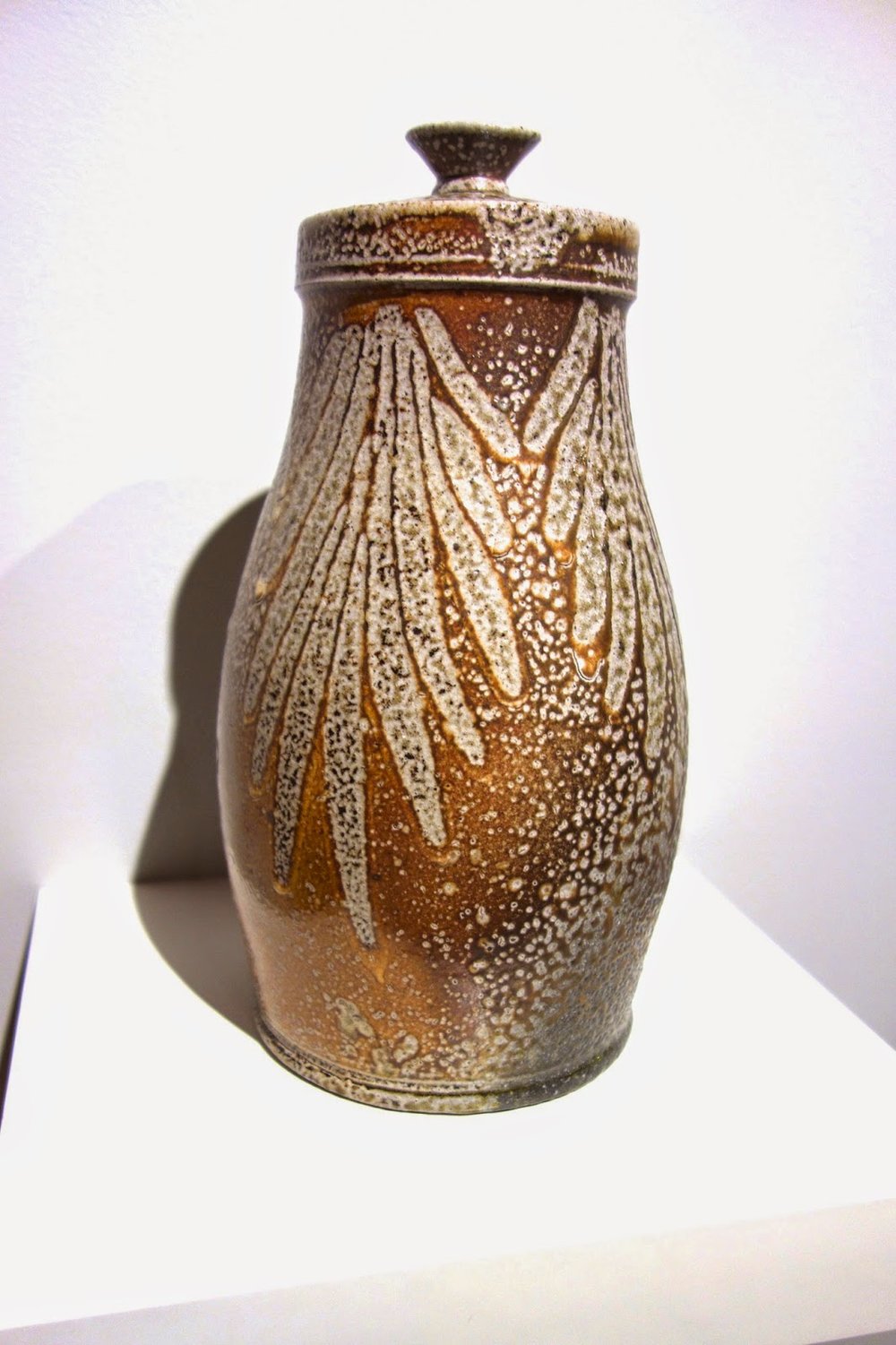 |
| Adrian King, Canister Jar, Stoneware, 2012 ($200). |
 |
| Marian Baker, Two Teabowls, Porcelain, ($90 set). |
 |
| Matthew McGovern, 1997, Vase, Porcelain ($190) |
From here I stumbled into a little café with an interesting
tile exhibition downstairs and a more conceptual exhibit by an Indian artist
upstairs.
 |
| untitled, ceramic, David Allyn & Xander Marro |
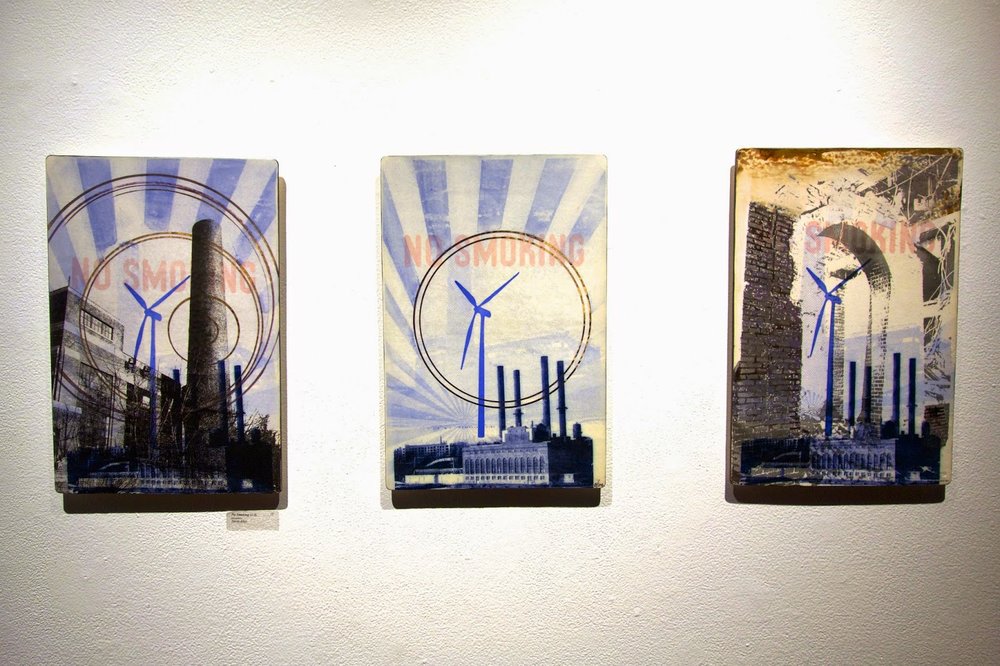 |
| No Smoking 1-3, David Allyn, Porcelain. |
 |
| No Smoking 2, David Allyn, Porcelain. |
 |
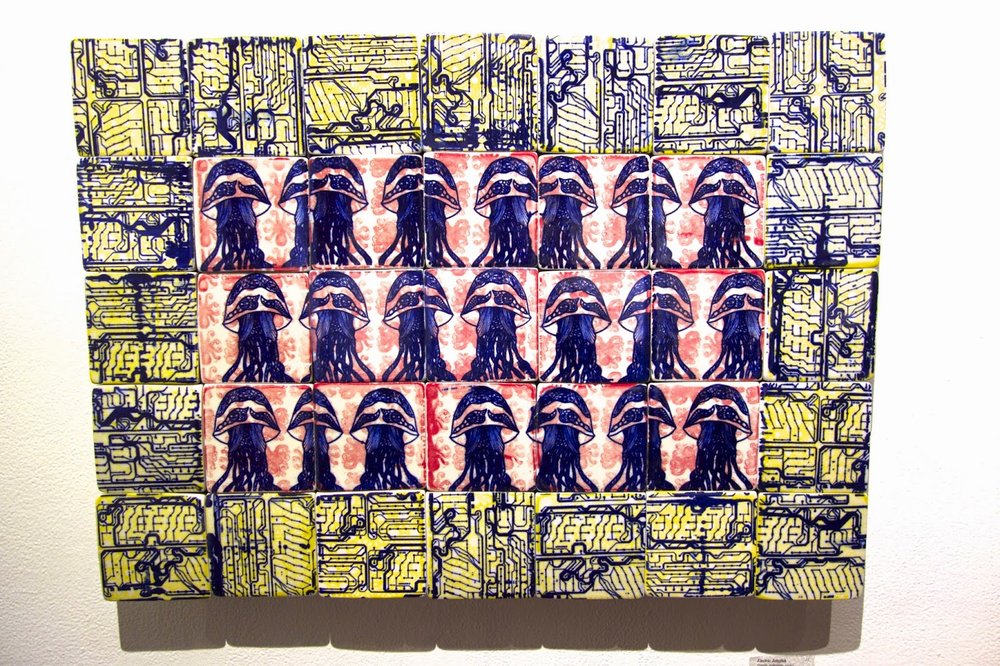
| Is This Sci-Fi Enough for You? Ceramic, Harrisson Bucy & John Wyand and Joan Wyand |
 |
| Drunkards Path, Ceramic Underglaze, Oxides, Muffy Brandt & Nidal Fakouri. |
Follow me upstairs...
 |
| One over two, Two over one, Ashwini Bhat, Anagama fired stoneware, text from "Burning Towers, Standing Wall," by Forrest Gander. |
 |
| One over two, Two over one, Ashwini Bhat. |
 |
| One over two, Two over one, Ashwini Bhat. |
 |
| One over two, Two over one, Ashwini Bhat. |

 |
| Sharlene Valenzuela |
 |
| Sharlene Valenzuela |
 |
| Sharlene Valenzuela |
 |
| Sharlene Valenzuela |
 |
| Jim Koudelka |
 |
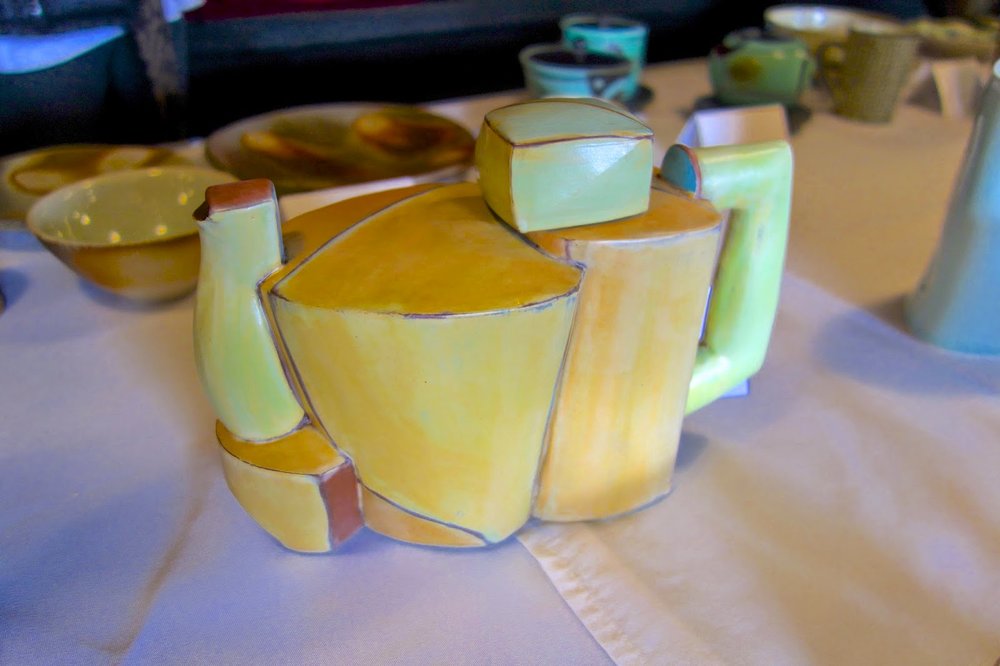
| Karen Thuesen Massare |
 |
| Marty Fielding |
 |
| Jim Connell |
 |
| Robbie Lobell |
 |
| Lee Atkins |
 |
| Kowkie Durst |
 |
| Peter Pincus |
 |
| Peter Pinkus |
 |
| Camila Friedman-Gerlicz |
 |
| Liz Quacknbush |
 |
| Debra Fritts |
 |
| Deborah Schwartzkopf |
 |
| Molly Hatch |
 |
| Matt Kelleher |
 |
| Priscilla Mouritzen |
 |
| Bruce Cochrane |
 |
| Linda Sikora |
 |
| Mike Helke |
 |
| Kari Radasch |
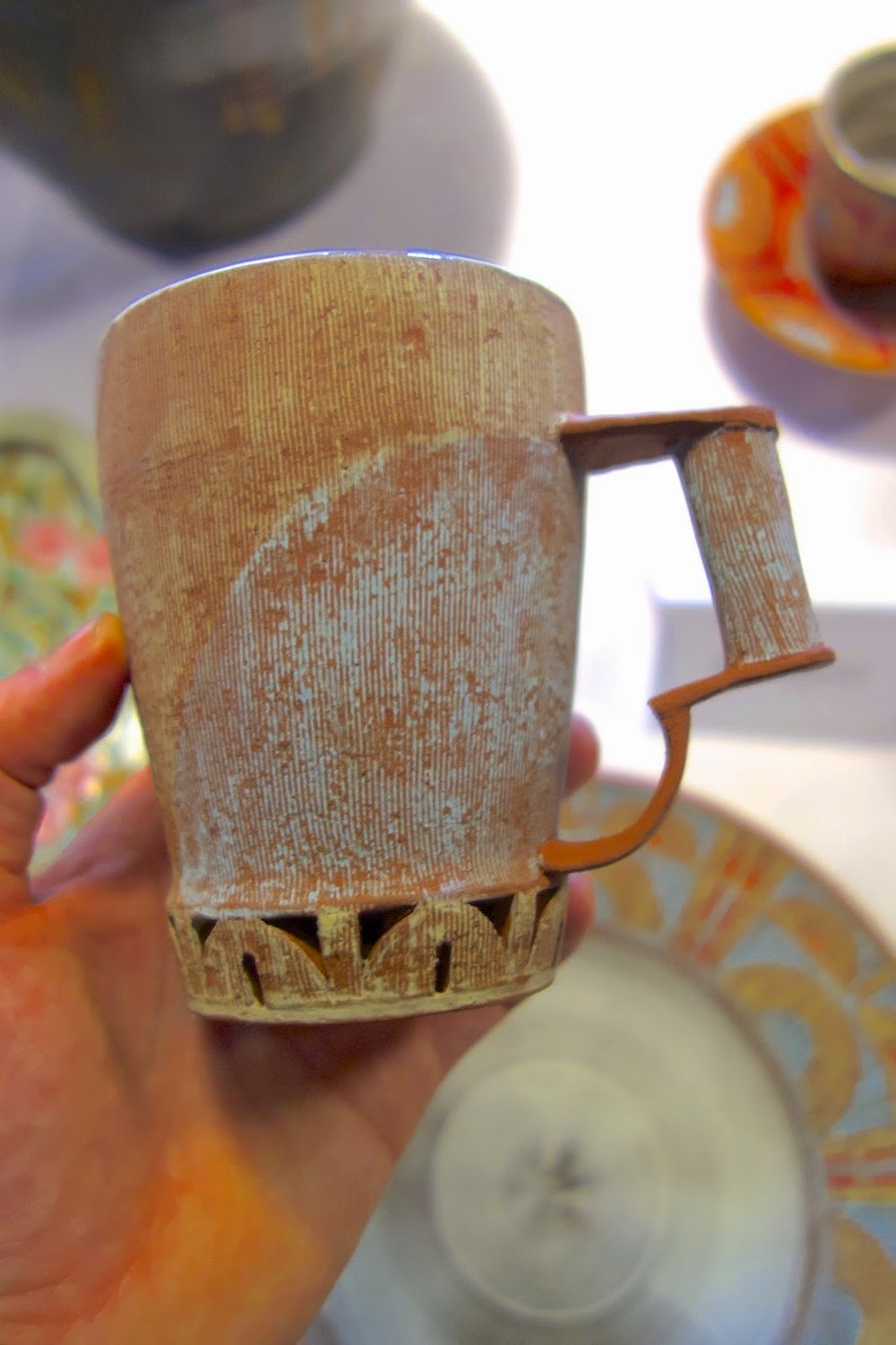 |
| Matt Repsher |
 |
| Simon Levin |
 |
| Jeremy Kane |
 |
| Sean O'Connell |
 |
| Sean O'Connell |
 |
| Maryann Webster |
 |
| Ted Saupe |
 |
| Claudia Olds Goldie |
 |
| Lindsay Oesterritter |
 |
| Kent McLaughlin |
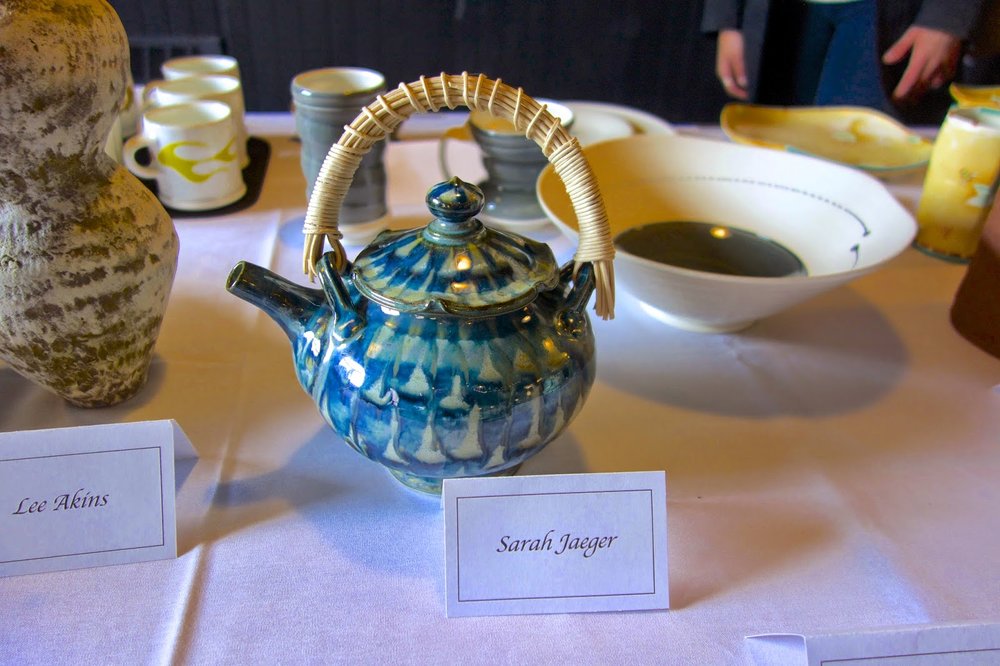 |
| Sarah Jaeger |
 |
| Lee Akins |
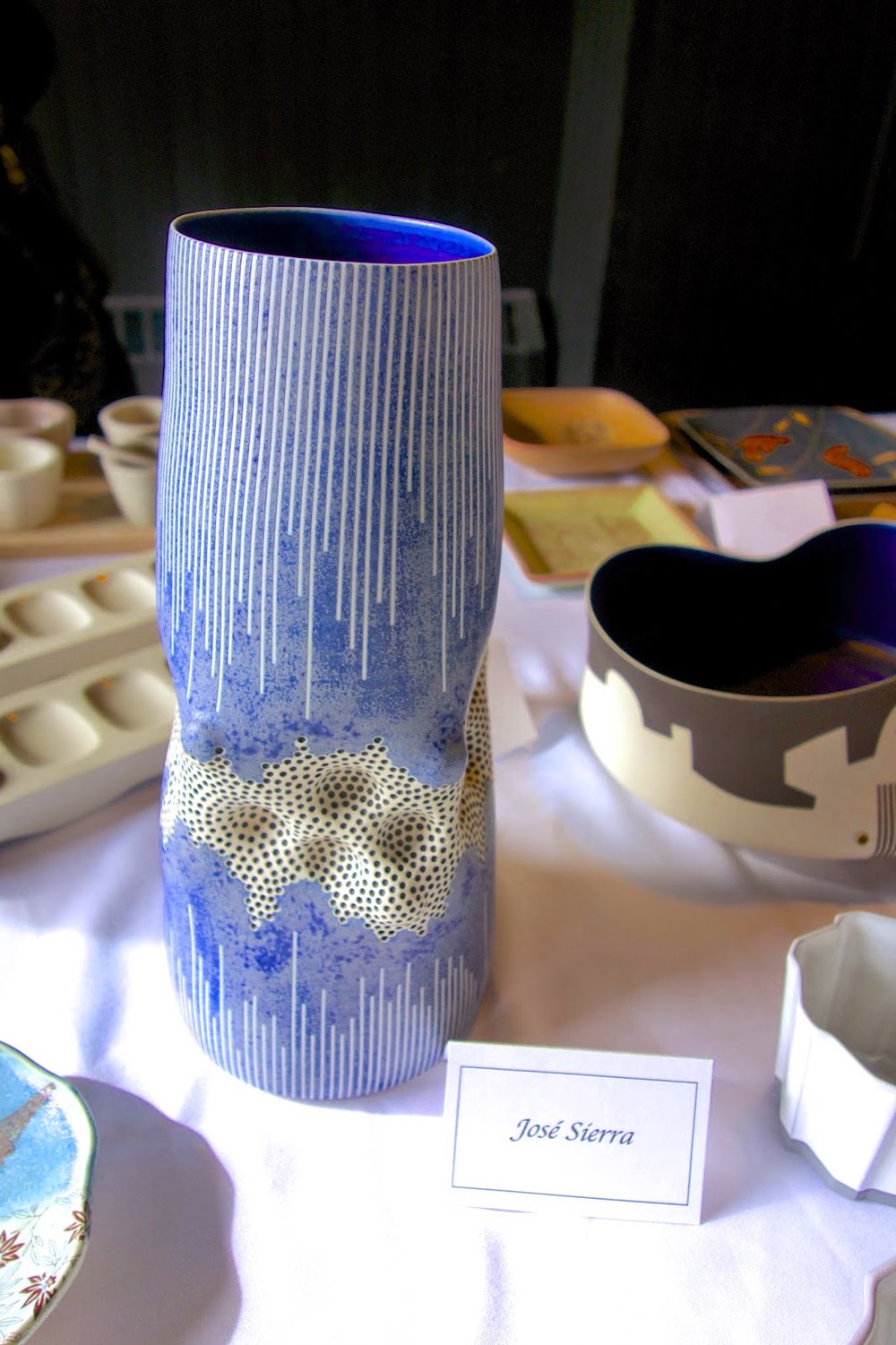 |
| José Sierra |
After spending awhile at La Mesa, time was wearing on, so I made my way back to the Conference
Centre to see the opening lectures. I have to say I found the keynote speaker a tad disappointing. Frederick Douglass Opie was very knowledgeable, but not really a pottery person. It was interesting but lacked the sense of honesty that the rest of the conference exuded. I will admit though that I fell
asleep, so cannot give a full review.
The other introductory talks were good though and the music afterwards was excellent: Ethel -- a group pushing the boundaries of string instruments -- played an exuberant set ranging from their own arrangements to interpretations of classics such as Kashmir. It was certainly in keeping with the “Lively Experiment” theme and the audience seemed to appreciate the sounds on display. Afterwards I went home, put on some Miles Davis, ran a bath and studied my programme guide, circling the next day's necessities. Thursday looked like it was going to be very busy.
Visit to Robbie Lobell's Pottery in Coupeville, Washington
Before we moved to Brooklyn last summer, Lauren and I took a trip up to Seattle with her parents, Pat and Nelson. It was July and we were hoping for fine weather, but the rumours were true; it tipped it down for the first couple of days of our trip. Thankfully the rain didn't last, so we took the ferry over to Whidbey Island to visit Robbie Lobell's pottery. I had wanted to visit her for a couple of years after narrowly missing the chance to work with her at La Meridiana in Tuscany.
Robbie makes flameware for use in the kitchen, which appeals to me as I love to cook. Flameware pots can be used directly on a stove top and endure severe temperature shocks. You can take them directly from the freezer to the oven without worrying about cracking. To do so requires much testing and specificity of materials. Things I was keen to learn!
The drive from Seattle was beautiful, and we felt like we were in the middle of nowhere, almost disbelieving when we arrived at the pottery, tucked away in the woods of Coupeville, down a little rickety road.
We were greeted by two friendly pooches called Kozmo and Maestro, then Robbie and her partner Maryon Attwood. We took a tour of the premises, including a sneak peak into their wonderful garden. The plums were plump, ripe and absolutely gorgeous.
I was most taken with this pot, and very much want to make one at some point. It is by Louise Harter:
Into the studio...
This picture hangs right above Robbie's wheel. She told us how much she had learned from these two ladies. Mikhail Zakin just passed away in 2012.
Her original kiln, up by the house:
As we walked around, we noticed pots of a different style and found out that Robbie had two apprentices: Clovy Tsuchiya and Jordan Jones. Mary Krochmalny, a summer intern from the Rhode Island School of Design, was also staying and working there.
After we had done the full tour of the studio by their house, Robbie took us down to the "production annex," which is an additional space they rent. Robbie is moving towards a more mechanised process of producing her flameware, using a large hydraulic press. It was very interesting to see her process developing. Here is her new 142 cubic foot car kiln (propane-fueled soda vapor).

Back to the house and into the showroom! Robbie's pots are beautiful, but also extremely durable and a pleasure to use. Pat and Nelson very kindly bought one for Lauren and I as a marriage present and we have enjoyed many a meal from it; from cassoulet to mac n cheese to coq au vin.
It was an adventure going to visit Robbie and her team out in Coupeville, and I recommend a visit if you are in the area. It's a truly stunning place. The apprentices seemed to be having a great time, and I would recommend the program to young potters looking to develop their own style and learn the art of soda firing.
Robbie makes flameware for use in the kitchen, which appeals to me as I love to cook. Flameware pots can be used directly on a stove top and endure severe temperature shocks. You can take them directly from the freezer to the oven without worrying about cracking. To do so requires much testing and specificity of materials. Things I was keen to learn!
The drive from Seattle was beautiful, and we felt like we were in the middle of nowhere, almost disbelieving when we arrived at the pottery, tucked away in the woods of Coupeville, down a little rickety road.
 |
| A headland on the drive from Seattle |
 |
| We stopped to admire a stony beach |
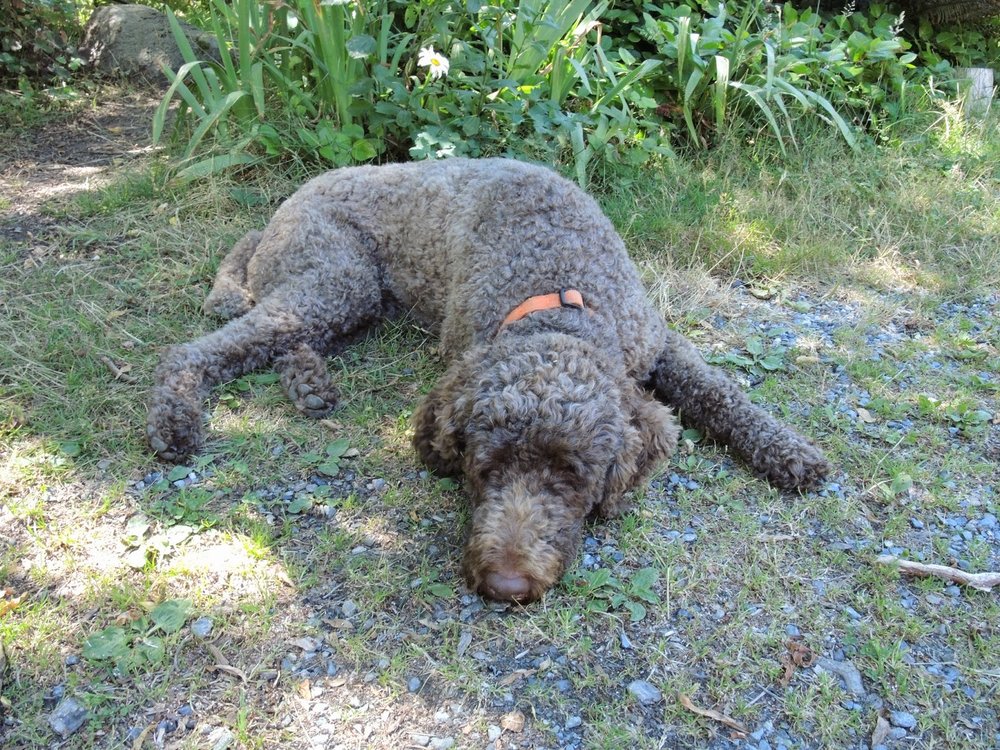 |
| Kozmo taking a load off. |
 | |||
| The vegetable garden |
I was most taken with this pot, and very much want to make one at some point. It is by Louise Harter:
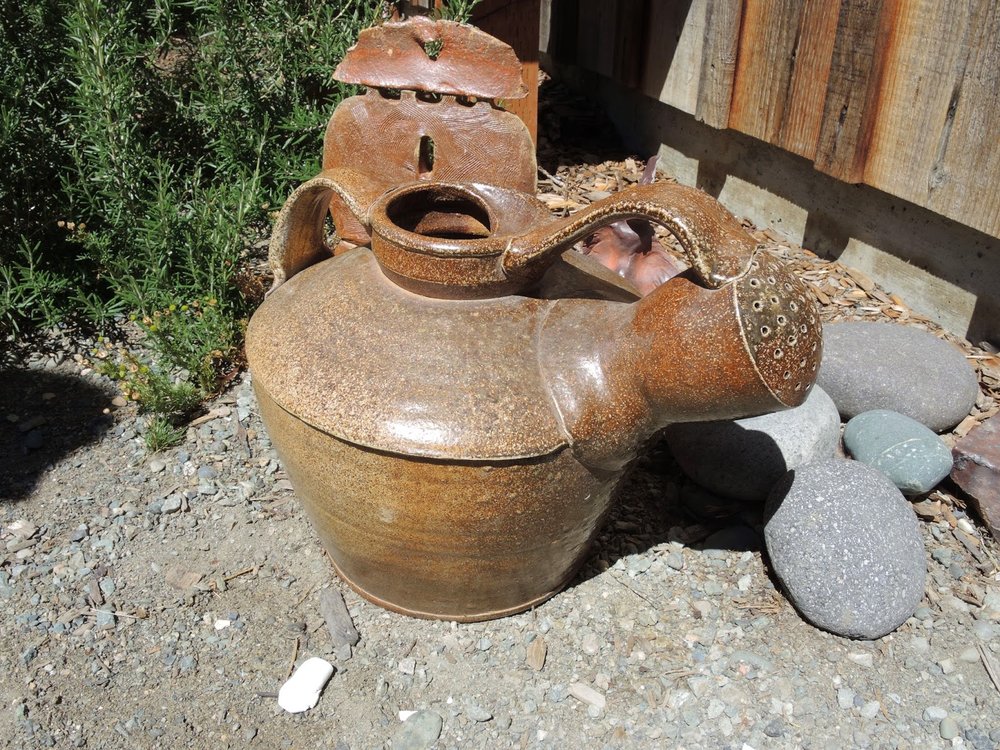 |
| Best watering can ever? |
 |
| Maestro |
 |
| Neat tools |
 |
| Robbie by her wheel |
 |
| Robbie's two teachers and mentors, Karen Karnes and Mikhail Zakin |
Her original kiln, up by the house:
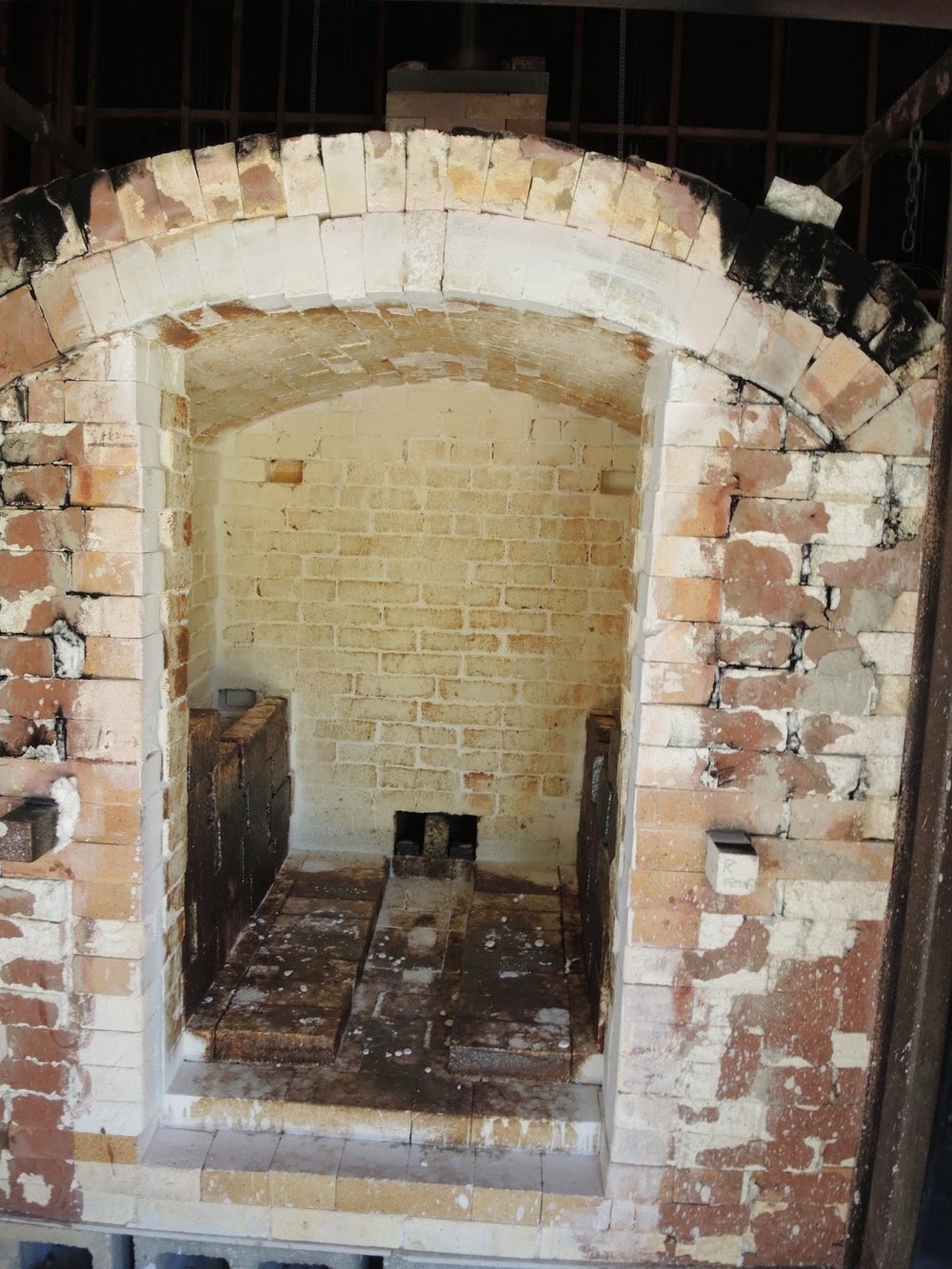 |
| 70 cubic feet propane-fueled soda vapor kiln. |
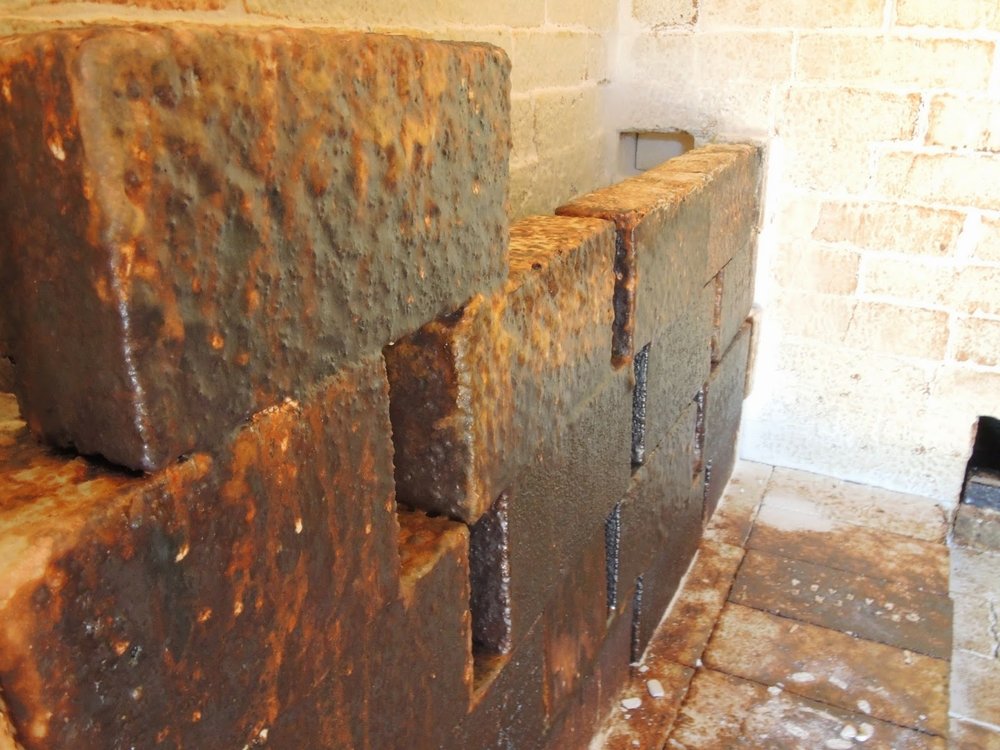 |
| Look at the build up on those bricks! |
 |
| Bisque pots by Clovy Tsuchiya |
 |
| Bisque pots by Mary Krochmalny |
 |
| Animal mugs and poof pots by Jordan Jones |
 |
| Close up of some of Jordan Jones' pots |
 |
| Teapot by Clovy Tsuchiya |
 |
| I love the shape of these teapots; they look like snails! |
 |
| It is on rollers which makes it much easier to load. |
 |
| Kiln shelves |
 |
| Robbie explaining the press |
 |
| Molds for the handles |
 |
| Mold for a casserole dish |
 |
| They are seriously heavy duty pieces of equipment |
 |
| This is the hydraulic press which gives 130,000 pounds per square inch! |
 |
| Bisque ware |
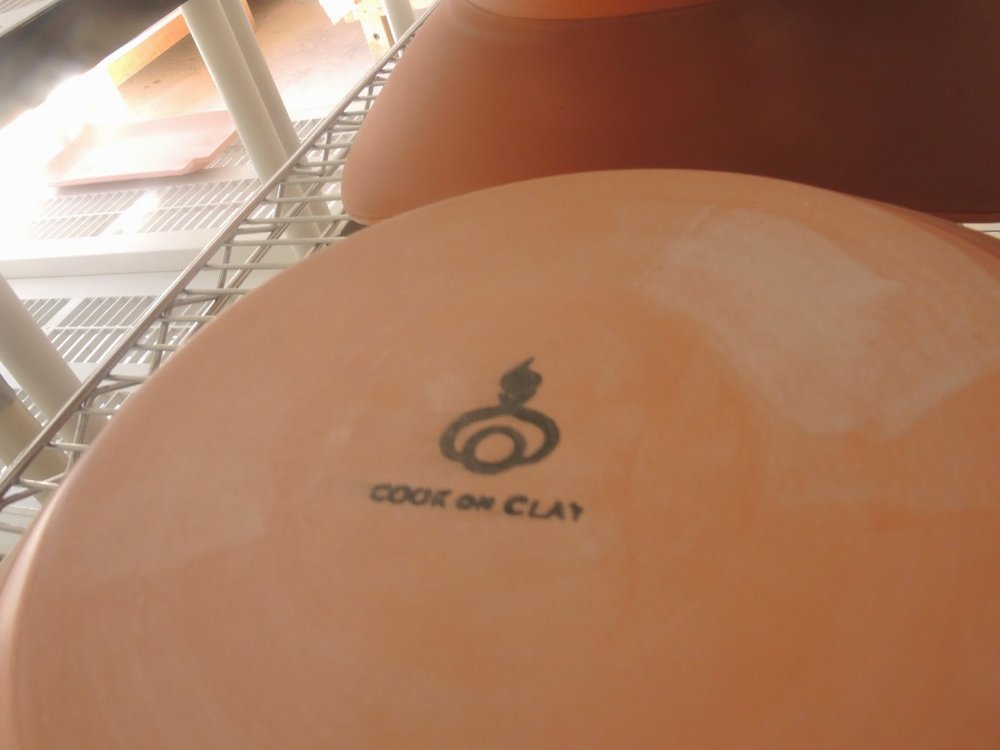 |
| Stamp |
 |
| Glazed and waiting to be fired |
Back to the house and into the showroom! Robbie's pots are beautiful, but also extremely durable and a pleasure to use. Pat and Nelson very kindly bought one for Lauren and I as a marriage present and we have enjoyed many a meal from it; from cassoulet to mac n cheese to coq au vin.

 |
| Mugs and oil/vinegar bottles. |
 |
| Square casserole dishes |
 |
| This beauty is the one we took home with us. |
 |
| You can see how pleasing the surface of the clay is here |
It was an adventure going to visit Robbie and her team out in Coupeville, and I recommend a visit if you are in the area. It's a truly stunning place. The apprentices seemed to be having a great time, and I would recommend the program to young potters looking to develop their own style and learn the art of soda firing.
Happy holidays! and, my first time lapse!
To anyone and everyone who reads this, I wish you a very merry Christmas and a happy New Year. I had planned on going back to England this holiday, but my travel and work permit from the US government only arrived in mid December, by which point the flights were far too expensive. So Lauren and I went back to stay with her folks in Los Angeles. It could be worse. The weather is pretty fabulous, we've soaking up as much sun as possible before going back to cold reality in New York. On Christmas Day we followed the strict Jewish tradition of going out to a movie and then Chinese food. The Chinese was a shambles but The Interview was surprisingly funny, and we did not get nuked, either, which felt like an extra Christmas present.
I was planning to post lots of pics of pieces I have made recently, however I managed to lose my phone. It is in Dallas Love Field somewhere. The lost and found people couldn't find it even though I emailed them a map of the precise location. Pish tush. So I have been set back somewhat.
However I did get a pretty exciting toy for xmas which I managed to have a brief play with. It is a GoPro Hero 3 (silver edition), complete with extras such as a chest harness, head strap, etc. So I figured I could do some pottery videos with it strapped to my chest or head. However, upon attempying this, I realised that the camera has to be super close to the clay for it to be visible due to the extreme wide angle.
So I strapped it to a stool. It wasn't totally secure and somewhat impeded my motions on the peddle, but I was kind of in a rush and managed anyway. I decided to try out the time lapse function. It consists of 776 photographs taken one every half a second. When they are all put together and played like a video it condenses down to 25 seconds.
So here it is below: the first in my GoPro Pottery series! Good cheer to yea and have a glass of port on me!
I was planning to post lots of pics of pieces I have made recently, however I managed to lose my phone. It is in Dallas Love Field somewhere. The lost and found people couldn't find it even though I emailed them a map of the precise location. Pish tush. So I have been set back somewhat.
However I did get a pretty exciting toy for xmas which I managed to have a brief play with. It is a GoPro Hero 3 (silver edition), complete with extras such as a chest harness, head strap, etc. So I figured I could do some pottery videos with it strapped to my chest or head. However, upon attempying this, I realised that the camera has to be super close to the clay for it to be visible due to the extreme wide angle.
So I strapped it to a stool. It wasn't totally secure and somewhat impeded my motions on the peddle, but I was kind of in a rush and managed anyway. I decided to try out the time lapse function. It consists of 776 photographs taken one every half a second. When they are all put together and played like a video it condenses down to 25 seconds.
So here it is below: the first in my GoPro Pottery series! Good cheer to yea and have a glass of port on me!
Visit to Mark Hewitt's Pottery, North Carolina
The night after we stopped at Cave Creek Pottery (covered in my last
post), we trundled along the back roads of North Carolina to Mark
Hewitt's pottery in Pittsboro. Patti gave us a loaf of her excellent
homemade bread to take along. We all met together in Italy; Doug was
part of the group taking Mark's class at La Meridiana.
Watching Mark throwing a 5 foot tall flower pot and hat stand in Italy was the first time I have ever seen pots thrown on this scale. I had seen videos of different techniques, such as Lady Kwali at the Abuja Pottery, but never in person. Lady Kwali comes to mind because she trained with Michael Cardew just as Mark Hewitt did. In person it was amazing, he built the pot up with such ease. Spending time with him and seeing his skills made me realise I had to visit Mark's pottery at some point. Mark comes from Stoke-on-Trent; his family were behind the bone China manufacturers, Spode. But instead of following his family into industrial ceramic production he forked out on his own, into the studio pottery tradition. After apprenticing for three years with Michael Cardew he also apprenticed with Todd Piker in Connecticut before settling in Pittsborough (in 1983) to build up his own studio.
When we arrived, Mark was out at a meeting at the North Carolina Pottery Center. Carol, his wife (who I also met in Italy and who is very involved with managing the pottery) brought us inside and dished up a cheese platter with thick slices of Patti's bread and a selection of preserves to keep the wolf from the door. Jon, Mark's newest apprentice, took us on a brief tour of the place before we headed out for some local beef burgers at a pub nearby. Carol is big on locally produced food and locally sourced funds, and recently wrote this great book.
The
next morning we got to have a proper look around. The kiln had just
been fired and sat clammed up, still warm after the 90th firing. Mark
stamps the bottom of each pot with the number of the firing; when you walk around and pick up a mug from
firing 3, he can tell you when it was and about the intricacies of the
firing. It also encourages collectors to get a piece from every firing.
The workshop has a dirt floor, which is now all knobbly and cobbled
through years of heavy use. It feels terribly authentic. The space was clean, ready for the kiln
opening in a few days, so there were no pots out drying but the air was thick with the weight of their missing forms. The grounds
around the pottery are beautiful, with a pond and a new apple orchard recently planted by Carol. A shed has been converted into a gallery for
most of the pots, whilst the really large ones sit outside on pedestals.
Lauren and I helped re-price some of the pots in the gallery as a group of ladies were stopping by that afternoon, and then I got involved with Adrian and Jon mixing clay. It was hot dusty work which abruptly ended when the belt came apart at the stapled seam. Mark and I headed to a nearby town to get a new attachment, chatting about all sorts on the way, from his apprenticeship with Cardew to the potential for me becoming his next apprentice. It would be a great experience, I think. Adrian, who has been apprenticing there a while, is making sweet pots. Plus the area around the pottery is stunning. But enough words, now for some pictures.




It is a great place full of magnificent pots (I didn't take any pics of the ones inside but there were countless beauties) and I can't wait to return sometime soon, perhaps for a kiln firing.
My next post will be about some of the pots I have been making here in New York!
Watching Mark throwing a 5 foot tall flower pot and hat stand in Italy was the first time I have ever seen pots thrown on this scale. I had seen videos of different techniques, such as Lady Kwali at the Abuja Pottery, but never in person. Lady Kwali comes to mind because she trained with Michael Cardew just as Mark Hewitt did. In person it was amazing, he built the pot up with such ease. Spending time with him and seeing his skills made me realise I had to visit Mark's pottery at some point. Mark comes from Stoke-on-Trent; his family were behind the bone China manufacturers, Spode. But instead of following his family into industrial ceramic production he forked out on his own, into the studio pottery tradition. After apprenticing for three years with Michael Cardew he also apprenticed with Todd Piker in Connecticut before settling in Pittsborough (in 1983) to build up his own studio.
When we arrived, Mark was out at a meeting at the North Carolina Pottery Center. Carol, his wife (who I also met in Italy and who is very involved with managing the pottery) brought us inside and dished up a cheese platter with thick slices of Patti's bread and a selection of preserves to keep the wolf from the door. Jon, Mark's newest apprentice, took us on a brief tour of the place before we headed out for some local beef burgers at a pub nearby. Carol is big on locally produced food and locally sourced funds, and recently wrote this great book.
 |
| We must be at the right place. |
Lauren and I helped re-price some of the pots in the gallery as a group of ladies were stopping by that afternoon, and then I got involved with Adrian and Jon mixing clay. It was hot dusty work which abruptly ended when the belt came apart at the stapled seam. Mark and I headed to a nearby town to get a new attachment, chatting about all sorts on the way, from his apprenticeship with Cardew to the potential for me becoming his next apprentice. It would be a great experience, I think. Adrian, who has been apprenticing there a while, is making sweet pots. Plus the area around the pottery is stunning. But enough words, now for some pictures.
 |
| The front of their house |
 | ||||
| I love the surface of this pot. |
 |
 |
| Ooooh look at those drips. |
 | ||||||||
 |
| You could fit a whole lot of honey in that pot |
 |
| One of the Hewitt cats |
 |
 |
| Close up. |
 |
| Looking in on the kiln shed |
 |
| The kiln-it is fairly massive |
 |
| Side door of the kiln, clammed up. |
 |
| Shed/gallery on the left, pedestals awaiting new pots in the middle. |
 |
| Crazy shapes |
 |
| Apprentices pots lined up |
 |
| Inside the shed/gallery |
 |
| Mark with his current apprentices Adrian (left) and Jon (right), fixing the belt. |
My next post will be about some of the pots I have been making here in New York!
Visit to Cave Creek Pottery, North Carolina
On our roadtrip across the country from L.A to New York, we went through North Carolina in order to visit some potters. North Carolina has more potteries than any state by far; it's a hotbed of ceramic activity. I met Doug and Patti Hubbs whilst at La Meridiana Ceramics School, in Tuscany. I was an assistant and Doug a student with Patti coming along for the trip. They were both lovely, and I saw that Doug was an excellent potter. We kept in touch and they supported our India project, so when we knew we'd be in the vicinity a visit was definitely in order.
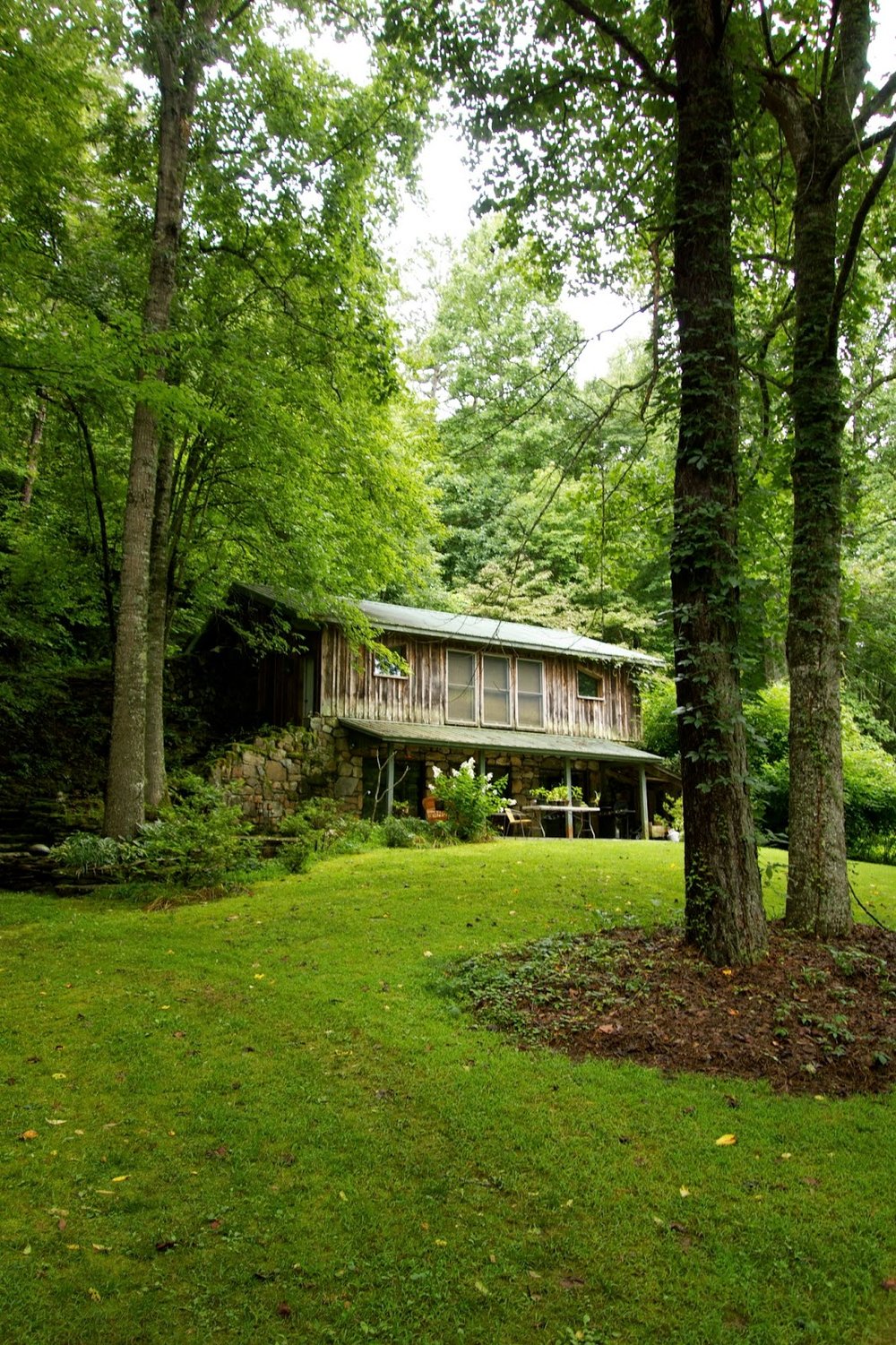
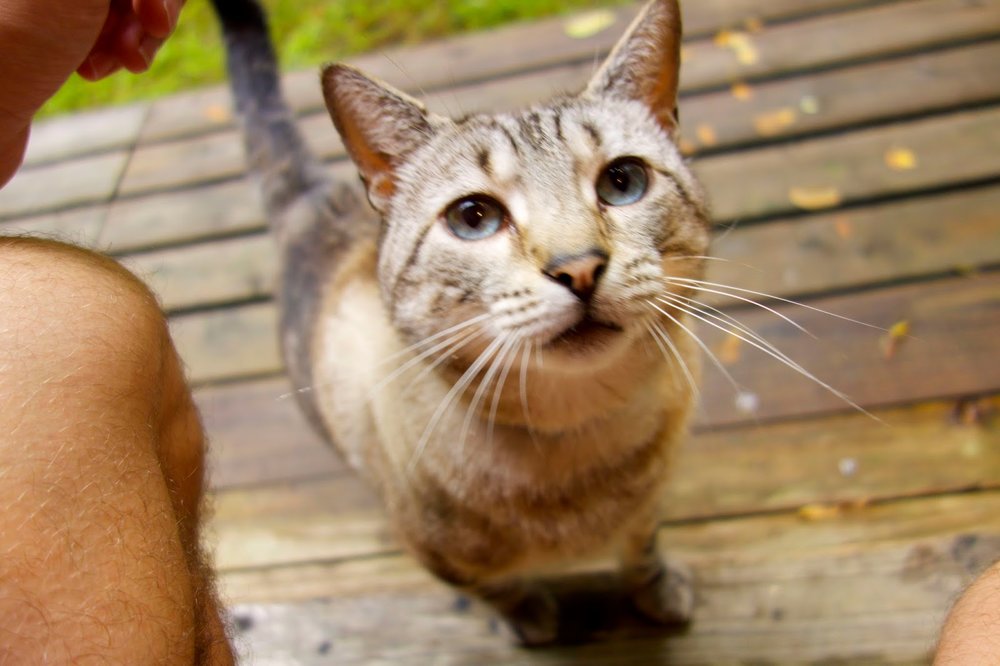
Their house is on "Over Creek Road" and you quite literally have to cross a creek to get to the house. As Lauren's red Toyota (Lucille) whooshed through the water and we made it across it felt like we were in a magical place. The grounds are encircled by forest and their house is built into the side of the hill. Everett the cat greeted us first; he is a magnificent cat, a mountain cat. About twice the size of normal house cats, we thought he must be a Maine Coon. Apparently he catches rabbits amongst other things. Doug, Patti and Everett took us on a walking tour of the property to see the veg patch, pond, pottery gallery etc. As night was falling we saw a deer run across the glade.
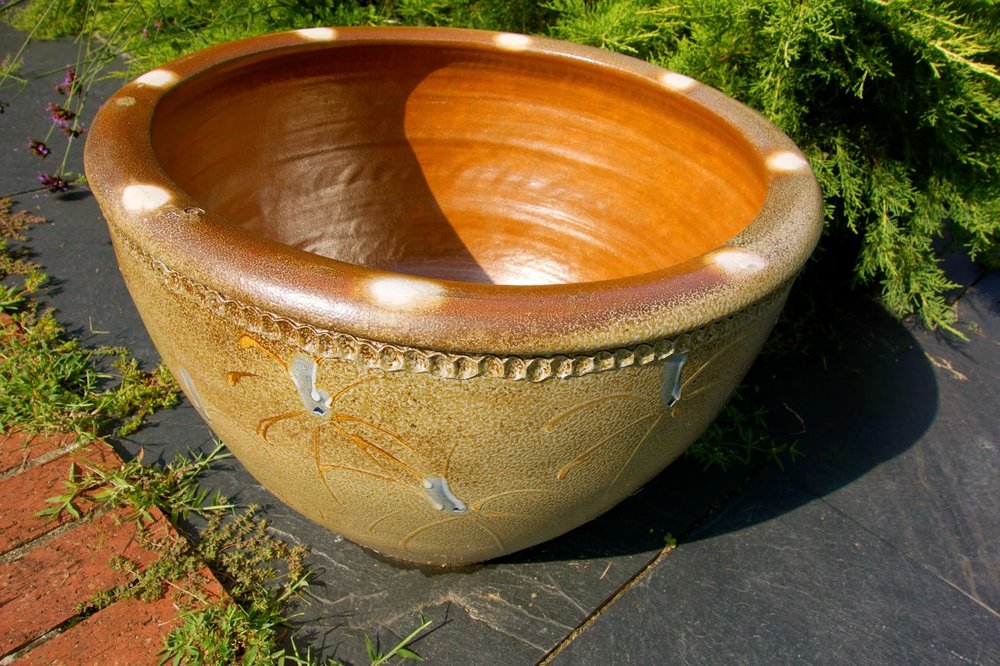
Patti and Doug asked us to choose a pot as a present for getting married a few weeks previous to our visit. It was a tough choice, but we went for a large shallow bowl similar to the ones below. We almost hung it on the wall but it's too useful, holding all of our onions, garlic, potatoes etc in the kitchen.

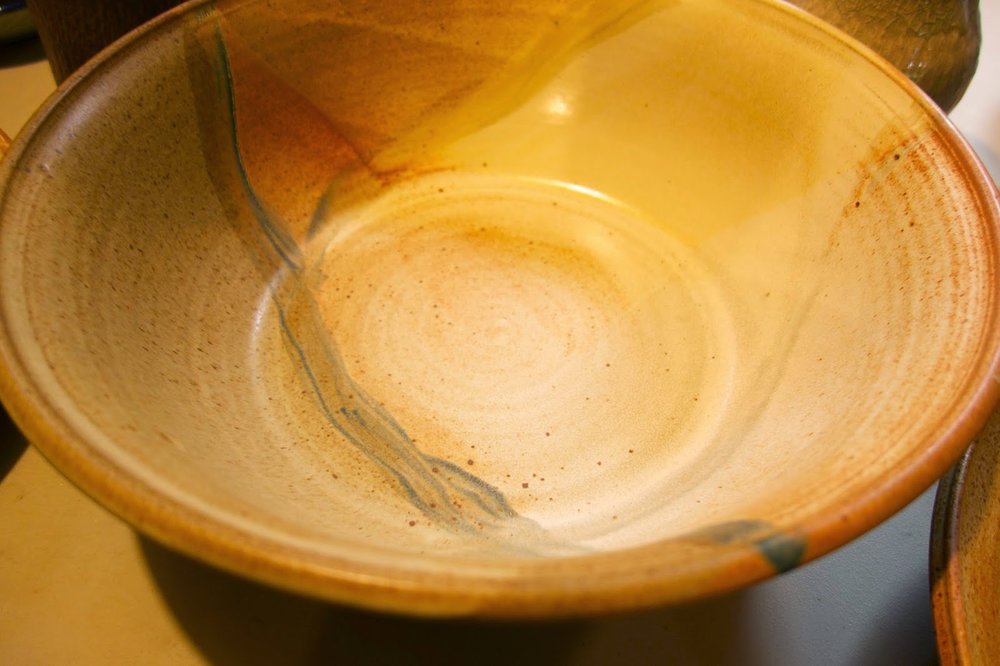
The gallery was stocked floor to ceiling with pots from multiple different firings. The ones at the bottom of the picture below were super shiny metallic from a heavy reduction raku.

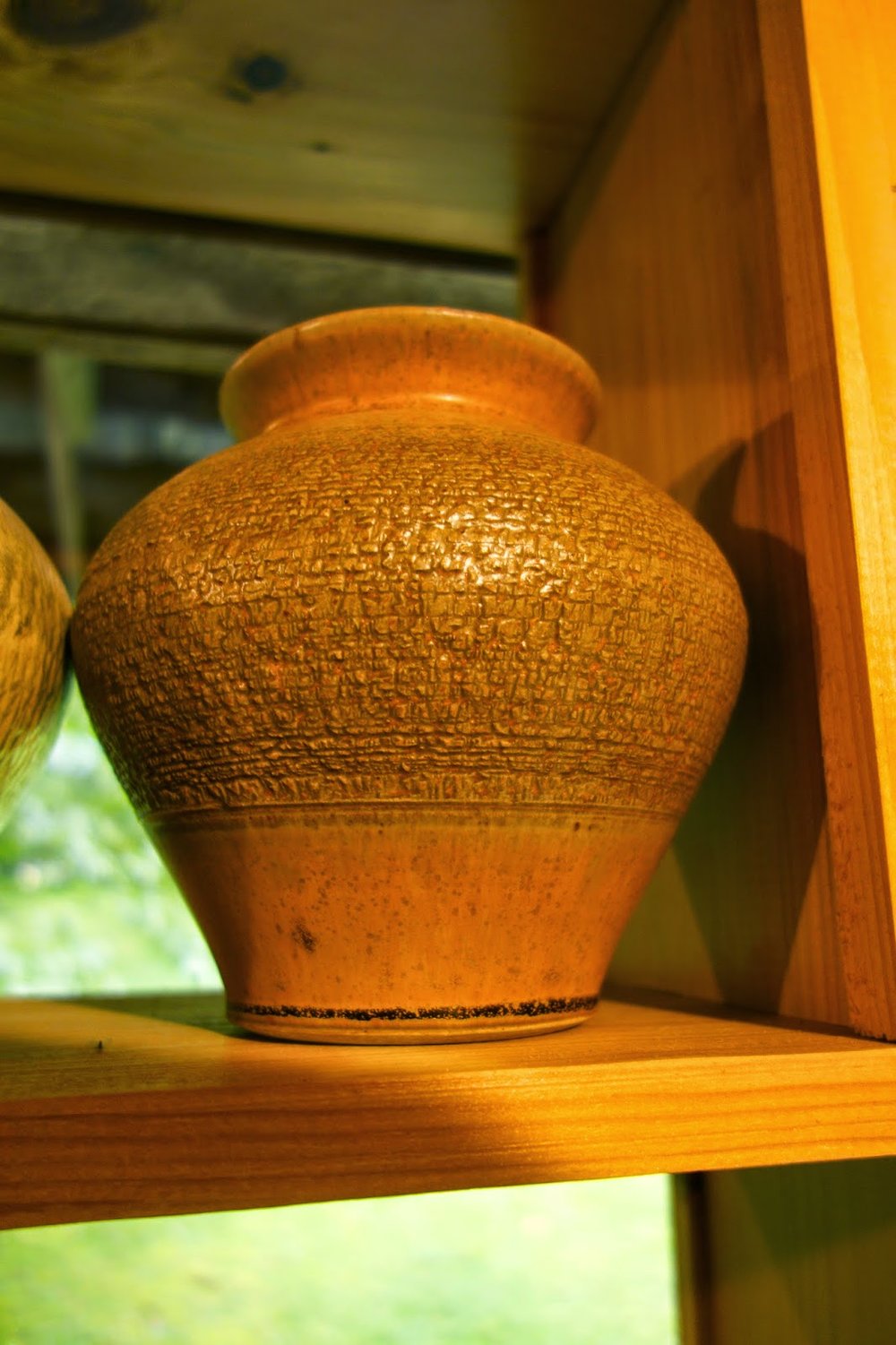
Doug's signature technique is to chatter his pots at the leather hard stage to give a textured finish to them. Here's a clear example:
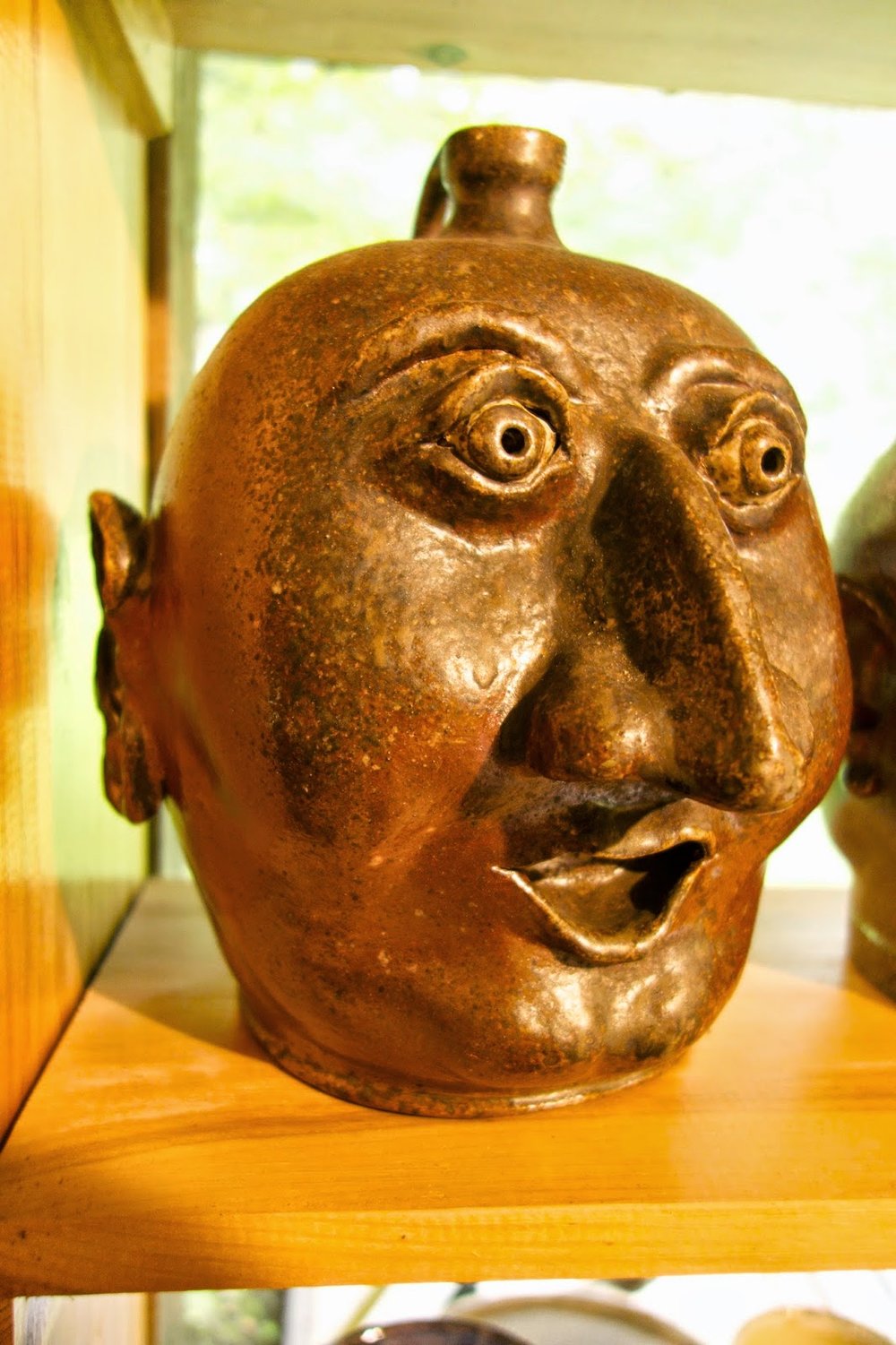
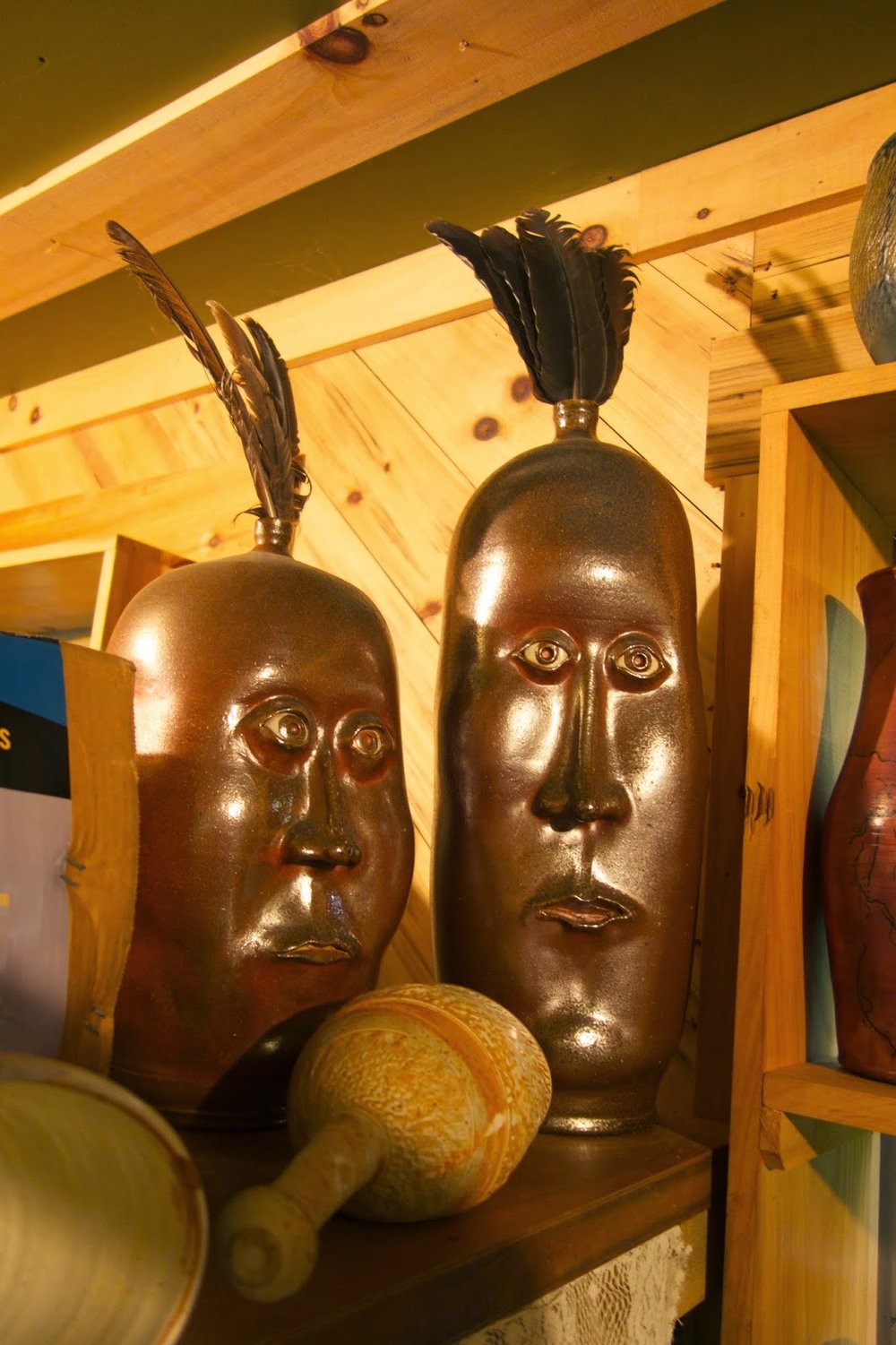
Doug doesn't just make functional ware, though; he also experiments with sculpture, such as these lively face jugs:



And finally, two little critters who were hiding in the corner of the room. I nearly missed them...


It was a truly lovely visit and we can't wait to go back at some point.Here's a link to the Cave Creek website: http://cavecreekpottery.com/
Their house is on "Over Creek Road" and you quite literally have to cross a creek to get to the house. As Lauren's red Toyota (Lucille) whooshed through the water and we made it across it felt like we were in a magical place. The grounds are encircled by forest and their house is built into the side of the hill. Everett the cat greeted us first; he is a magnificent cat, a mountain cat. About twice the size of normal house cats, we thought he must be a Maine Coon. Apparently he catches rabbits amongst other things. Doug, Patti and Everett took us on a walking tour of the property to see the veg patch, pond, pottery gallery etc. As night was falling we saw a deer run across the glade.
 |
| Doug and Patti's house. |
 |
| Everett the big friendly cat |
 |
| Fireplace |
 |
| Doug's Pottery Gallery |
 |
| Lauren holding the pot they gave us as a wedding present. |
 |
| Back window of the gallery |
 |
| Side window |
 |
| Window sill pots |
 |
| Pot graveyard |
 |
| A plate I found in the graveyard |
 |
| Guardian Elephant |
 |
| Pig pot |
 |
| Lauren with Everett. Look how big he is! |
The gallery was stocked floor to ceiling with pots from multiple different firings. The ones at the bottom of the picture below were super shiny metallic from a heavy reduction raku.
 |
| Many unusual pots! |
 |
| Top shelf. |
 |
| Horse hair firing |
 |
| Great red colouring on this low fired pot. |
 |
| Drinking vessels |
 |
| I particularly like these ones, they seem so alive. |
 |
| Tea set. |
 |
| Various ladles |
 |
| A beautiful plate made with glass; unfortunately, it cracked in the firing |
 |
| Big wise face jugs |
It was a truly lovely visit and we can't wait to go back at some point.Here's a link to the Cave Creek website: http://cavecreekpottery.com/
How To Start A Worm Farm
New York now has food recycling bins which is a great step forward for the city, the only thing is, (and you can call me selfish for this), but I don't want to give my vegetable scraps away to the city. I want to make them into lovely compost to feed my new rooftop garden in the spring.
So a few weeks ago I started a compost bin up on the roof. I'd take our scraps up there and turn the mix with a length of wood every day. However, reading online articles online about how to effectively compost your waste, I was struck by the amount of people who say that worms are the quickest and best way to get the most beautiful unctuous 'black gold' compost.
Here is my video where I show you how to put together your very own worm farm. Believe it or not there are actually a number of worm farm videos on youtube already, but here is my effort anyway. I hope you enjoy it! More info etc on the process below.
This is not a new idea. It has been around a while and even has a fancy name: in high-vaulted worm circles it is called vermiculture or vermicompost. After researching the subject in depth, I'm sold. Cornell University has a big ongoing worm research project. They have found that worm castings (what is left once they have munched your waste) is an excellent alternative to pesticides: it not only nourishes your soil but actually helps plants fight off pests and diseases.
The worms provide compost that is "7 times richer in phosphates, 5 times richer in nitrogen, and 11 times richer in potash than the average lawn soil" [according to Uncle Jim], as well as helping suppress plant diseases. We aren't talking about your standard earth worms, these are "red wrigglers" specifically bred for the purpose. Red wigglers, or Eisenia foetida, don't burrow like your standard earth worms. They are a very sociable breed of worm, living well in close, highly-populated conditions.
Anyway, that's enough about the worms. Let's get on with it.

The diagram above is basically what I followed, adapting it slightly to use five gallon buckets.You can use bought bins from a hardware store but you can also find five gallon buckets many places (restaurants etc). The only things I had to buy were the tap and the worms.
What you need:
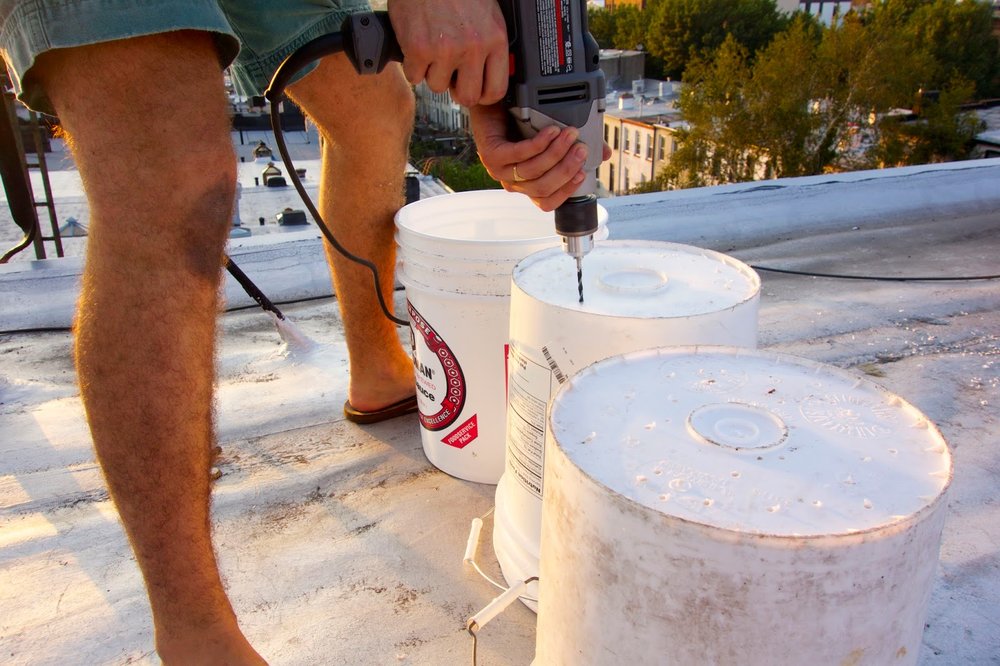
I used a fairly small drill bit for the holes in the sides to stop flies getting in and a slightly larger one for the holes between the buckets so the worms can wriggle through and play on any level.
In terms of maintaining the worm farm all you have to do is regularly feed the worms... fruit and vegetable scraps are best, ideally cut into small pieces as they only have tiny mouths. I have been avoiding citrus peel and onion/garlic skins and pits of fruits. Also remember to keep them moist!
So a few weeks ago I started a compost bin up on the roof. I'd take our scraps up there and turn the mix with a length of wood every day. However, reading online articles online about how to effectively compost your waste, I was struck by the amount of people who say that worms are the quickest and best way to get the most beautiful unctuous 'black gold' compost.
Here is my video where I show you how to put together your very own worm farm. Believe it or not there are actually a number of worm farm videos on youtube already, but here is my effort anyway. I hope you enjoy it! More info etc on the process below.
This is not a new idea. It has been around a while and even has a fancy name: in high-vaulted worm circles it is called vermiculture or vermicompost. After researching the subject in depth, I'm sold. Cornell University has a big ongoing worm research project. They have found that worm castings (what is left once they have munched your waste) is an excellent alternative to pesticides: it not only nourishes your soil but actually helps plants fight off pests and diseases.
The worms provide compost that is "7 times richer in phosphates, 5 times richer in nitrogen, and 11 times richer in potash than the average lawn soil" [according to Uncle Jim], as well as helping suppress plant diseases. We aren't talking about your standard earth worms, these are "red wrigglers" specifically bred for the purpose. Red wigglers, or Eisenia foetida, don't burrow like your standard earth worms. They are a very sociable breed of worm, living well in close, highly-populated conditions.
FUN FACT ~ Red Wriggler worms can double their population every 90 days.
Anyway, that's enough about the worms. Let's get on with it.
The diagram above is basically what I followed, adapting it slightly to use five gallon buckets.You can use bought bins from a hardware store but you can also find five gallon buckets many places (restaurants etc). The only things I had to buy were the tap and the worms.
What you need:
- x3 Five Gallon Buckets (available for free at many places, such as sushi restaurants)
- x1 Five Gallon Bucket Lid
- x1 Drill
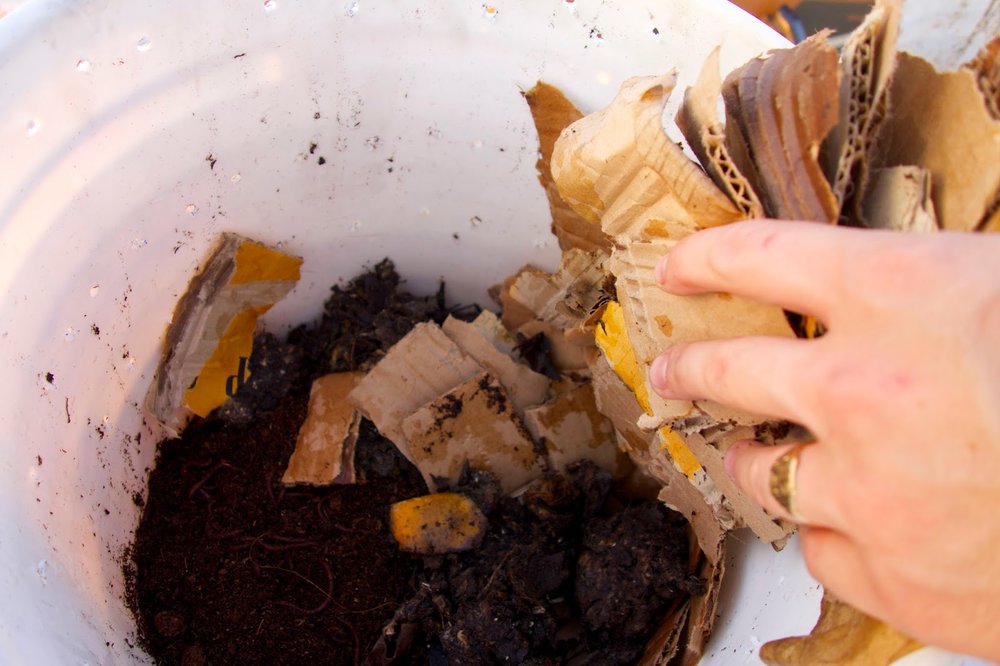
- x3 cardboard boxes (ripped up to make worm bedding)
- x1 plastic tap
- x500 or 1,000 Red Wriggler Worms (I got mine from Uncle Jim-he has a much bigger operation!)
 |
| My worm supplier. |
 |
| Drilling time. |
 |
| Homemade cardboard worm mattress. |
 |
| I added some soil to make the worms extra comfy. |
 |
| In go the worms and some food! |
 |
| I hope the worms were as happy as me. |
 |
| They don't like light so its good to give them a good covering of cardboard. |
 |
| Making the bed. |
 |
| This is luxury for a worm! |
 |
| The final product. Pretty much free and guaranteed to make beautiful compost for the garden. |
 |
| A deserved Baba beer. |
In terms of maintaining the worm farm all you have to do is regularly feed the worms... fruit and vegetable scraps are best, ideally cut into small pieces as they only have tiny mouths. I have been avoiding citrus peel and onion/garlic skins and pits of fruits. Also remember to keep them moist!