
Wood-Fired Ceramics Exhibition, "Connected By Fire" at the Blue Spiral Gallery in Asheville, NC. June 2017.
Last month saw a great many wood-fire potters congregating in North Carolina. The International Woodfire Conference took place at STARworks NC, from June 8th-11th, with a week of pre-conference activities beforehand. I was lucky enough to be able to scoot up to the mountains of western NC to see the exhibitions going on and meet lots of great potters.
I spent a good bit of Saturday at Josh Copus' compound where two kilns were being busily loaded and anther being built. Josh curated Connected By Fire at the Blue Spiral Gallery in Asheville around a core group of artists who in turn invited others into the fold. I didn't manage to make it to the opening, but I got the place to myself on Sunday morning and had time and space to photograph the work. I did miss a cabinet of cups which was secreted away on another floor of the gallery, and a few of my pics were inexplicably blurry and had to be left out, but I saw most of it.

I thought it was a delightful display of wood-fired ceramics. The variety of surfaces is astounding; from the warm, glazed surfaces of Bandana Pottery's work, to the dramatic flashing achieved by Copus and Knoche, to the subtler, somber tones of David Peters' work, to the dark, stormy ash build up on Ben Richardson's Deflection pieces. There were surprises, too, such as Jeff Shapiro's ice flow piece which reminded me of an icing accident on a basalt cake, or Will Dickert's angular platters which had me imagining how many different types of nuts I could lay my hands on (seriously nice nut display opportunities), or Mr Oh's bizarre, whimsical wood fired sculptures.

The firings of the pieces in the show is crucial to their success. Speaking with Josh Copus, he said that he is thinking about the placement of every pot as he's making it in the studio, and not only this but that different local clays end up in different areas of the kiln based on how they look at different temperatures and levels of oxidation or reduction. You can see the care and consideration that was taken in the way these pieces were placed in the kiln and fired.

Many of the potters use local materials and their work exhibits a raw sensibility: a sense of the earth and the rocks and the geological processes that made them. Being a potter myself, these things greatly appeal to me. To know that slip came from the stream at the end of the potter's garden makes the piece so much richer. Seeing this work and talking with many of the artists involved was inspiring. To know that you can experiment with just about any material you find, and figure out whether it could be useful in a slip, glaze, or clay body, or even just as wadding to place pots on in the kiln, is very exciting.

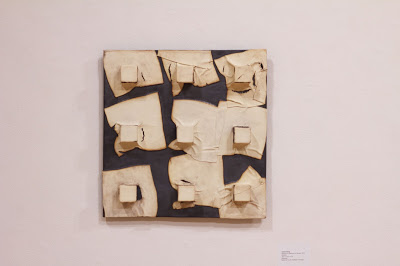
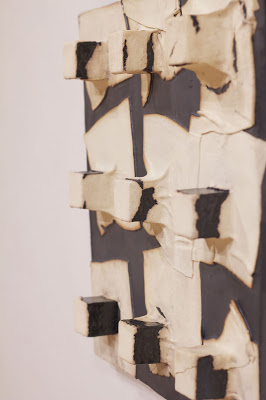
It has opened my eyes to a different way of looking at clay. In my daily studio practice, we take clay, made now by Takuro Shibata at his clay factory at Starworks; pug it, weigh it out, and throw functional pots with it. The clay has to be plastic and fine in order to stretch it thin and throw large bellies into mugs or jars. But much of the work in this exhibition veers dramatically away from this way of working; Akira Satake's boxes and sculptures are so far from thinly thrown mugs. It almost seems like he hasn't worked the clay at all: the finished pieces feel so raw and natural, like mountains and trees.
Well, that's probably enough gesticulating from me. Enjoy the pictures!

Akira Satake, Sculptural Box No. 1. Wood-fired porcelaneous clay. 7.25 x 7 x 6.5. $625.

Eric Knoche, Untitled Line. Wood-fired stoneware with slips. 21 x 19 x 6. $3,500.

Akira Satake, Sculpture No. 2. Wood-fired porcelaneous clay. 17.5 x 10.5 x 7. $4,500.

Eric Knoche, Abacus No. 3. Wood-fired stoneware with slips. 28 x 45 x 3. $2,700.

Akira Satake, Kohiki Vase No. 3 (left) & Kohiki Vase No. 1 (right). Wood-fired stretched slip stoneware. $685 & $625.

Eric Knoche, Horseshoe Cloud. Wood-fired ceramics. 18 x 14 x 5. $2,000.

Eric Knoche, Chain. Wood-fired stoneware with slip. 77 x 8 x 7. $3,000.

Eric Knoche, Miscellaneous Symbols and Tools. Wood-fired stoneware with slips. 30 x 50 x 7. $3,300.

Close-up of: Eric Knoche, Miscellaneous Symbols and Tools. Wood-fired stoneware with slips. 30 x 50 x 7. $3,300.

Close up of: Eric Knoche, Miscellaneous Symbols and Tools. Wood-fired stoneware with slips. 30 x 50 x 7. $3,300.

Judith Duff, Wave. Wood-fired ceramics. 9.5 x 13 x 6. $650.

Judith Duff, Shigaraki Clay Bottle. Wood-fired ceramics. 15.75 x 5.75 x 5.25. $600.

Judith Duff, Ikebana Form. Wood-fired ceramics. 5 x 17 x 3. $450.

Catherine White, Echo. Wood-fired stoneware with natural ash glaze. 17.5 x 11 x 11. $900.

Catherine White, Spokes. Wood-fired stoneware with natural ash glaze. 6.5 x 13 x 12.5. $400.

Catherine White, Striation (left) & Kite II (right). Wood-fired stoneware with natural ash glaze. $200 & $500.

Catherine White, Pulse. Wood-fired stoneware with natural ash glaze. 10 x 9 x 6.5. $400.

Eric Knoche, Abacus. Wood fired-stoneware with slip. 30 x 50 x 7. $2,700.

Tim Rowan, Box. Wood-fired native clay. 8 x 7 x 6. $800.

Tim Rowan, Vessel. Wood-fired native clay. 23 x 9 x 10. $3,000.

Eric Knoche, Puzzle No. 2. Wood-fired stoneware with slips. 9 x 24 x 5. $2,300.

Hyang Jong Oh, Three Birds (sold as set). Wood-fired ceramics with slip and glaze. 36 x 9 x 6. $2,000.

Hyang Jong Oh, Musician Pagoda. Wood-fired ceramics. 27 x 12 x 12. $1,800.

Ben Richardson, Cleave No. 1 & 2. Wood-fired ceramics. 8.5 x 6. $600 each.

Left: Josh Copus, Large Stone Vessel No. 5. Wood-fired wild clay. 29 x 14 x 9. $900.
Right: Josh Copus, Medium Stone Vessel No. 9. Wood-fired wild clay. 20 x 9 x 9. $450.

Josh Copus, Large Stone Vessel No. 12. Wood-fired wild clay. 26 x 17 x 17. $900.

Josh Copus, Large Stone Vessel No. 4. Wood-fired wild clay. 30 x 17 x 12. $900.

Josh Copus, Small Pixels (sold individually). Wood-fired wild clay. 46 x 34. $30.

Left: Shozo Michikawa. Natural Ash Twist Form No. 2. Wood-fired ceramics. 8 x 4.5 x 4.5. $2,000.
Middle: Shozo Michikawa. Natural Ash Vase. Wood-fired ceramics. 11 x 3.5 x 3.5. $2,000.
Right: Shozo Michikawa. Natural Ash Twist Form No. 1. Wood-fired ceramics. 7.25 x 4.5 x 4.5. $1,800.

Shozo Michikawa. Tanka Bowl. Wood-fired ceramics. 5.5 x 13 x 12. $2,500.

Shozo Michikawa. Natural Ash Pineapple Vase No. 2. Wood-fired ceramics. 6.5 x 6 x 6. $2,000.

Ben Richardson, Deflection No. 1 & 2. Wood-fired ceramics. 12 x 5 x 3. $500 each.

Ben Richardson, Deflection No. 2. Wood-fired ceramics. 12 x 5 x 3. $500.

Josh Copus, Large Stone Vessel No. 2 & No. 11. Wood-fired wild clay. 25 x 15 x 6 & 28 x 17 x 16. $900 each.

Josh Copus, Orb. Wood-fired ceramics. 7 x 8 x 8. $250.

Josh Copus, Large Orb Vessel. Wood-fired wild clay. 19 x 16 x 16. $900.

Ben Richardson, As Darkness Falls No. 1 & 2. Wood-fired ceramics. 6 x 5.5 & 7 x 5.5. $600 each.

Josh Copus, Erosion. Wood-fired wild clay. 7 x 7 x 2. $240 each.

Will Dickert, Jar Study, No. 1. Wood-fired stoneware. 9 x 7 x 7. $200.

Will Dickert, Trough Form. Wood-fired stoneware. 8 x 9 x 28. $995.

Jeff Shapiro pieces. Details below.

Jeff Shapiro, Ice Flow Series No. 1. Wood-fired ceramics with natural ash deposit and glaze. 6.5 x 12 x 10. $1,600.

Jeff Shapiro, Untitled No. 1. Wood-fired ceramics with natural ash deposit and glaze. 21 x 9 x 4. $2,300.

Jeff Shapiro, Untitled No. 2. Wood-fired ceramics with glaze, ash, and shell marks. 15 x 17 x 4. $1,500.

Josh Copus, Large Stone Vessel No. 9. Wood-fired wild clay. 24 x 16 x 8. $900.

Will Dickert, Boat Form. Wood-fired stoneware. 6 x 8 x 22. $425.

Will Dickert, Linear Form. Wood-fired stoneware. 7 x 33 x 9. $975.

Michael Hunt & Naomi Dalglish, Fluted Oval Vase. Wood-fired local clay with Nuka glaze. 6.5 x 12 x 5. $175.

Michael Hunt & Naomi Dalglish, Onggi Shield Vase. Wood-fired local clay with slip and glaze. 19 x 14 x 5.5. $800.

Michael Hunt & Naomi Dalglish, Large Square Tray. Wood-fired local clay with wax resist and iron. 16 x 16 x 2. $475.

Michael Hunt & Naomi Dalglish, Carved Tray with Handles. Wood-fired local clay and Nuka glaze. 4.5 x 17.5 x 2. $125.

Michael Hunt & Naomi Dalglish, Square Bottle. Wood-fired local clay with slip glaze. 11 x 5 x 5. $175.

Michael Hunt & Naomi Dalglish, Long Tray No. 1. Wood-fired local clay with slip, sgraffito and green deco. 22 x 7.5 x 2. $375.

Sandy Lockwood, Black Jar. Wood-fired salt-glazed stoneware. 7 x 3 x 3. $450.

Sandy Lockwood, Orange Platter. Wood-fired and salt-glazed stoneware. 10 x 10. $900.
Sandy Lockwood, Cups. Wood-fired and salt-glazed stoneware. 5 x 3. $105 each.

William Baker, Triangle Vase. Stoneware, thrown and altered. 7 x 11 x 5. $220.

William Baker, Square Bowl. Stoneware, thrown and altered. 8 x 11 x 11. $495.

William Baker, Bottle No. 1. Stoneware, thrown and altered. 15 x 6 x 6. $325.

William Baker, Bowl No. 2. Stoneware, thrown and altered. 7 x 8 x 8. $260.

Josh Copus, Large Stone Vessel No. 8. Wood-fired wild clay. 24 x 8 x 7. $700.

Close up: Josh Copus, Large Stone Vessel No. 8. Wood-fired wild clay. 24 x 8 x 7. $700.

Eric Knoche, Untitled Form No. 3. Wood-fired stoneware with slips. 36 x 24 x 14. $5,700.

Close up of: Eric Knoche, Untitled Form No. 3. Wood-fired stoneware with slips. 36 x 24 x 14. $5,700.

David Peters, Bowl. Wood-fired local stoneware. 5 x 13.5 x 13.5. $375.

David Peters, Seven Sided Jar. Wood-fired local stoneware. 14.5 x 17.5 x 17.5. $1900.

David Peters, Four Sided Jar. Wood-fired local stoneware. 8 x 13 x 13. $600.

Eric Knoche, Untitled Form No. 2. Wood-fired stoneware with slips. 18 x 16 x 14. $2,800.

Eric Knoche, Untitled Form No. 1. Wood-fired stoneware with slips. 16 x 18 x 15. $3,000.

Akira Satake, Sculpture No. 1. Wood-fired porcelaneous clay. 12.5 x 7.5 x 5. $1,800.

Akira Satake, Sculpture No. 5. Wood-fired porcelaneous clay. 6.25 x 8 x 7. $725.
Great Pots from the Traditions of North & South Carolina: Exhibition at the Pottery Center in Seagrove, North Carolina.
Over the past year, Mark has been busier than usual. As well as making his usual quota of pots, he's been helping to organise the International Woodfire Conference (which happened a few weeks ago) and the Great Pots exhibition that coincided with it. During the winter, after we 'd fired the salt kiln, Mark drove around the South meeting collectors and pickers and dealers, trying to find the very best examples of traditional North and South Carolinian pottery. The idea was to showcase the rich history of pot making in this area to all of the world-class woodfire potters who would be visiting for the conference.
The proceedings opened at the Pottery Center, with the Great Pots on display. We ate NC barbeque, (pulled pork, collards, hush puppies, and the like), chatted with new and old friends and took in the pots, excited for the weekend's events to come.
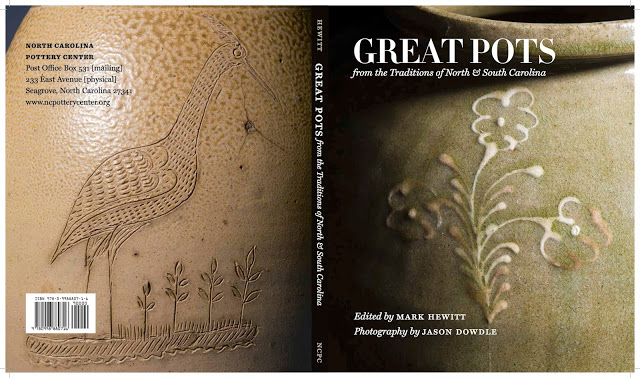
This exhibition and accompanying book (above; it can be purchased here) acts as a sequel to Mark's previous exhibition and book, The Potter's Eye. A few of the same pots were included, such the one from the cover of The Potter's Eye by Solomon Loy. It was a real treat to see this one up close! When I asked why he wanted a few of these previous pots, he simply said, "I just had to show those ones"... they acted as a starting point -- a measure of quality. The choice of pots was mostly a matter of which ones Mark particularly liked and felt needed to be shown.
This makes the exhibition all the interesting because his perspective is different from the usual art curator or collector. Being a potter, he appreciates all aspects of the pots, from the forms, to the decorations, to the way the handles were put on, to the firing, to the clay etc etc. In this way, the exhibition and accompanying book are truly a sequel to The Potter's Eye.
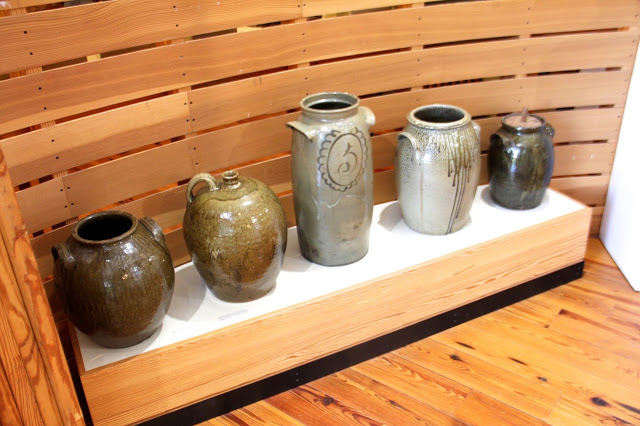
There are over 150 pots in the exhibition and book, each with a little lyrical note from Mark portending to why he included that particular pot. The pots are organised into five sections, with informative, engaging essays from authorities on them: Linda Carnes-McNaughton on earthenware and the pots from Alamance County, NC, Charles (Terry) Zug on alkaline and salt-glazed wares, Philip Wingard on South Carolina stoneware. As there were so many pots to fit into the Pottery center, Mark was creative in his display; arranging groups of pots together, almost in still life scenes. This was partly out of necessity but also inspired by an exhibition of ceramics called "Parades," organised by Gwyn Hanssen Pigott (2006-2008), at the Freer Gallery of Art in Washington DC.
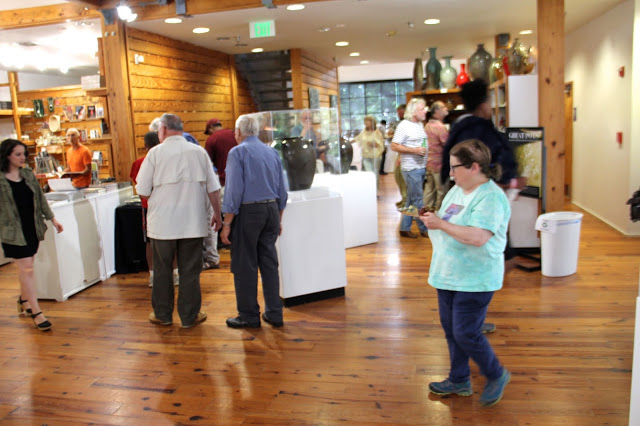
I went back and revisited the exhibition last weekend with less people around and was amazed by the quality and breadth of the work. It was wonderful to be able to walk around them slowly, feeling the surfaces and examining the clay bodies. The pots have a power in person; particularly the larger jars, churns, and jugs. I love the wide bellies, high shoulders, and strong forms of many of these pots. The wide range of wood-fired surfaces struck me too; all different permutations of wood ash deposits, salt and alkaline glazes, over and under fired, as well as dainty pinkish deer spots. I particularly enjoyed the accidental surfaces from firings gone awry; you can see some pots where the kiln bricks melted glassy drips onto them. But also, in contrast to these gnarlier examples, I loved seeing the crisp, delightful incising of Chester Webster's work.
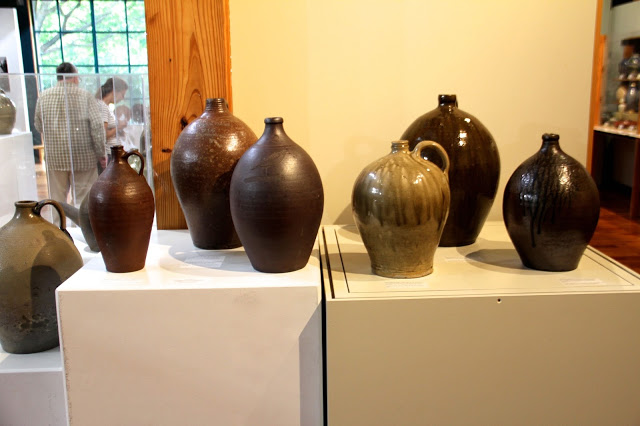
To start this post, I have included a few pictures of the exhibition as it was laid out in the Pottery Center. These quick snaps don't really do the pots justice, but give a sense of the exhibition. Below those are some of the pictures used in the book (which Mark kindly sent me), taken by professional craft photographer Jason Dowdle.
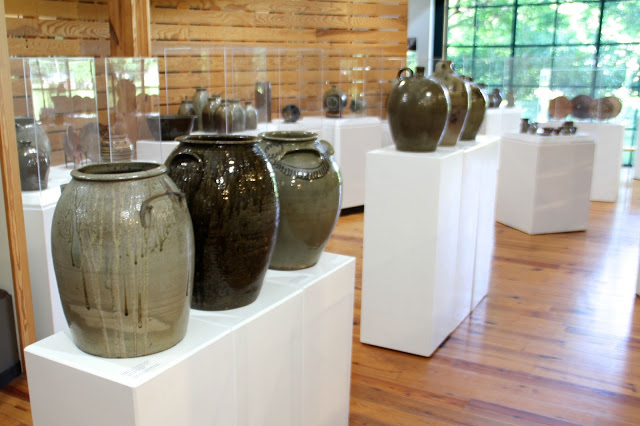

The exhibition is up until July 22nd, 2017, so get over to Seagrove and check it out if you can! If not, there's always the book. It is a very nicely put-together tome with excellent photographs, as you should get a taste of in this post.
Now on to Jason Dowdle's professional pictures. I've included the entries as they are in the book: with all the details of the pots and Mark's comments underneath. Enjoy!
Alkaline Glazed Stoneware (NC)
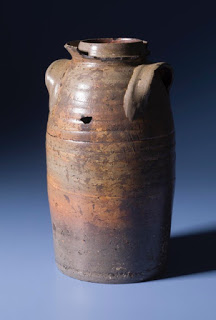
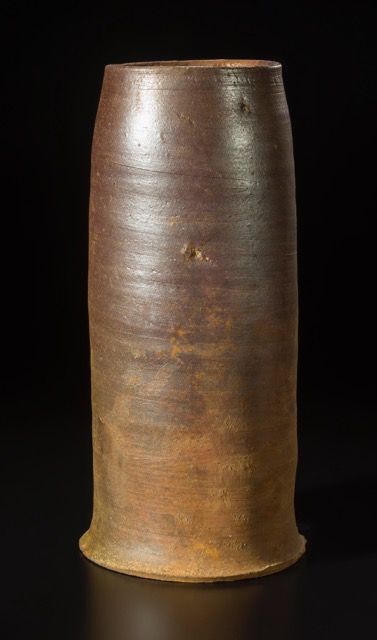
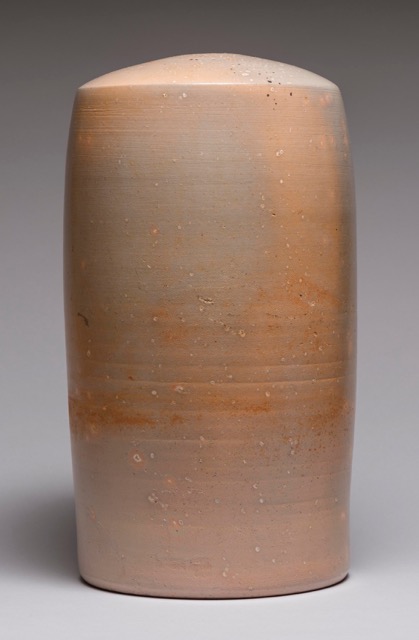
Alamance County (NC) Salt Glaze
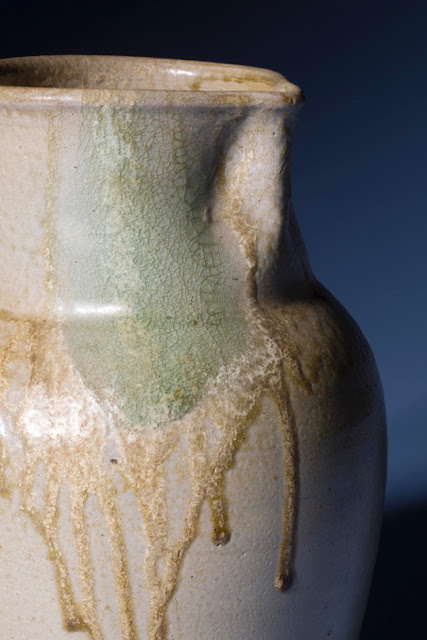
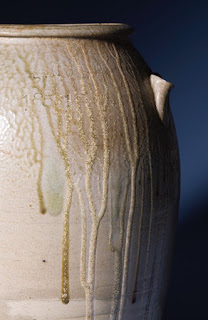
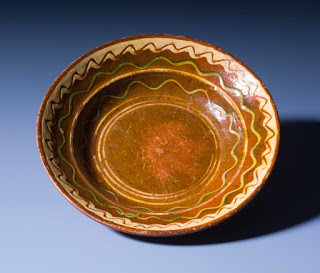
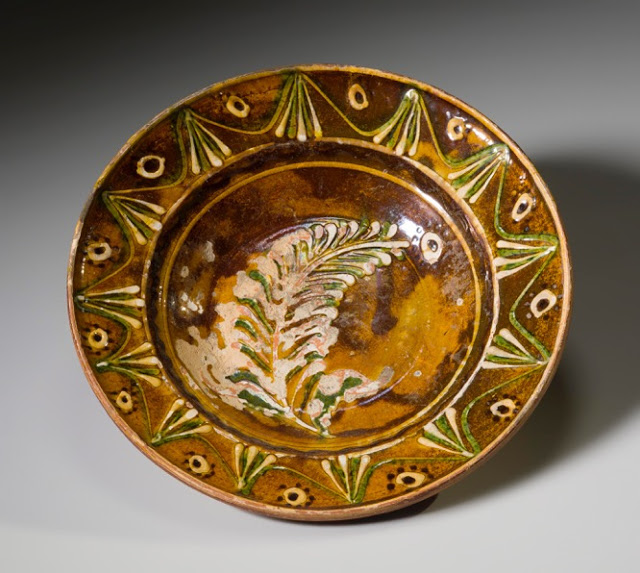
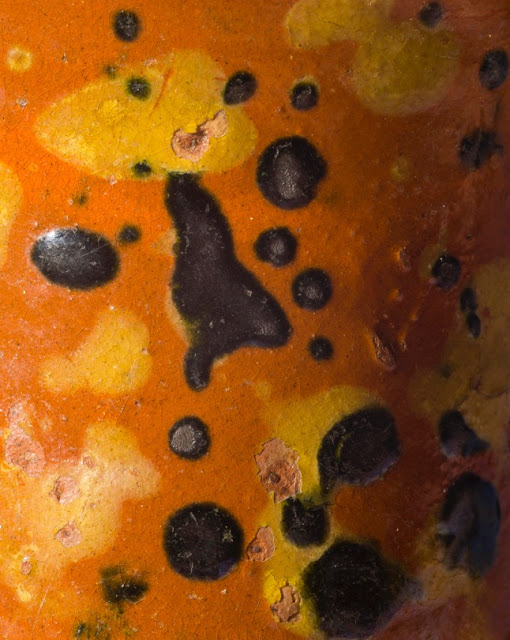
Earthenware from North Carolina


The proceedings opened at the Pottery Center, with the Great Pots on display. We ate NC barbeque, (pulled pork, collards, hush puppies, and the like), chatted with new and old friends and took in the pots, excited for the weekend's events to come.
This exhibition and accompanying book (above; it can be purchased here) acts as a sequel to Mark's previous exhibition and book, The Potter's Eye. A few of the same pots were included, such the one from the cover of The Potter's Eye by Solomon Loy. It was a real treat to see this one up close! When I asked why he wanted a few of these previous pots, he simply said, "I just had to show those ones"... they acted as a starting point -- a measure of quality. The choice of pots was mostly a matter of which ones Mark particularly liked and felt needed to be shown.
This makes the exhibition all the interesting because his perspective is different from the usual art curator or collector. Being a potter, he appreciates all aspects of the pots, from the forms, to the decorations, to the way the handles were put on, to the firing, to the clay etc etc. In this way, the exhibition and accompanying book are truly a sequel to The Potter's Eye.
There are over 150 pots in the exhibition and book, each with a little lyrical note from Mark portending to why he included that particular pot. The pots are organised into five sections, with informative, engaging essays from authorities on them: Linda Carnes-McNaughton on earthenware and the pots from Alamance County, NC, Charles (Terry) Zug on alkaline and salt-glazed wares, Philip Wingard on South Carolina stoneware. As there were so many pots to fit into the Pottery center, Mark was creative in his display; arranging groups of pots together, almost in still life scenes. This was partly out of necessity but also inspired by an exhibition of ceramics called "Parades," organised by Gwyn Hanssen Pigott (2006-2008), at the Freer Gallery of Art in Washington DC.
I went back and revisited the exhibition last weekend with less people around and was amazed by the quality and breadth of the work. It was wonderful to be able to walk around them slowly, feeling the surfaces and examining the clay bodies. The pots have a power in person; particularly the larger jars, churns, and jugs. I love the wide bellies, high shoulders, and strong forms of many of these pots. The wide range of wood-fired surfaces struck me too; all different permutations of wood ash deposits, salt and alkaline glazes, over and under fired, as well as dainty pinkish deer spots. I particularly enjoyed the accidental surfaces from firings gone awry; you can see some pots where the kiln bricks melted glassy drips onto them. But also, in contrast to these gnarlier examples, I loved seeing the crisp, delightful incising of Chester Webster's work.
To start this post, I have included a few pictures of the exhibition as it was laid out in the Pottery Center. These quick snaps don't really do the pots justice, but give a sense of the exhibition. Below those are some of the pictures used in the book (which Mark kindly sent me), taken by professional craft photographer Jason Dowdle.
The exhibition is up until July 22nd, 2017, so get over to Seagrove and check it out if you can! If not, there's always the book. It is a very nicely put-together tome with excellent photographs, as you should get a taste of in this post.
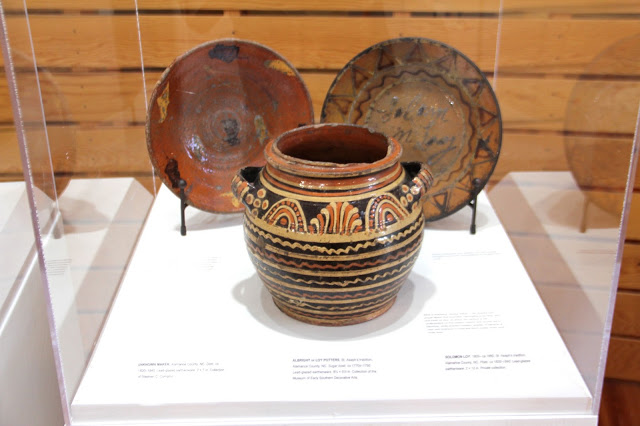
I love these earthenware pots, particularly the sugar bowl up front. It is so alive and expressive, over the top in its slip-trailed decoration but humble in form.
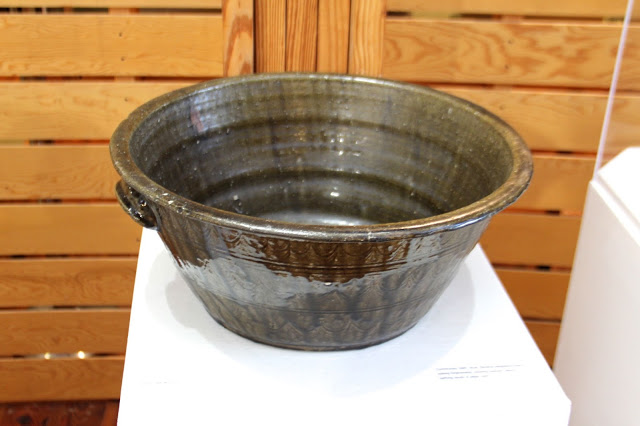
This large mixing bowl is amazing. The glaze must have been applied really thickly as it ran down and puddled in one side of the base.
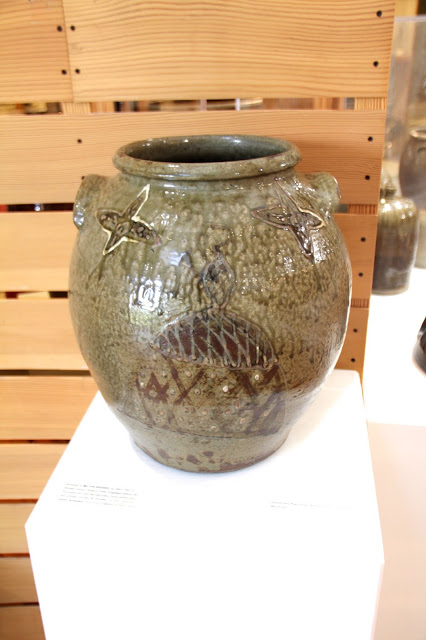
This pot is attributed to Milton Rhodes (1843-52). I find the decoration very odd. You can see it two ways; either a slip trailed woman in a hooped skirt is at the center, with flowers up above, or the flowers are eyes, her torso is a nose and her skirt is a gaping mouth. Great shape, but I find the decoration rather unsettling!
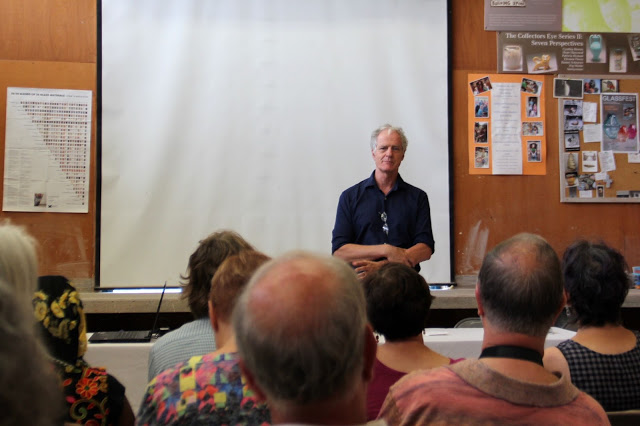 |
| Mr. Hewitt giving a talk about how the exhibition came to fruition, in the teaching wing of the Pottery Center. |
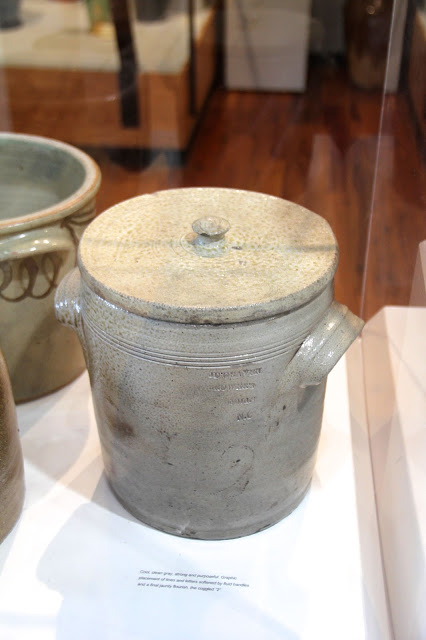
One gallon crock stamped JD CRAVEN BROWER'S MILL, N.C. I rather fancy this one as a bread bin.
Jugs!
I like how slender this whisky jug is. Pretty light too (not that I picked it up or anything).
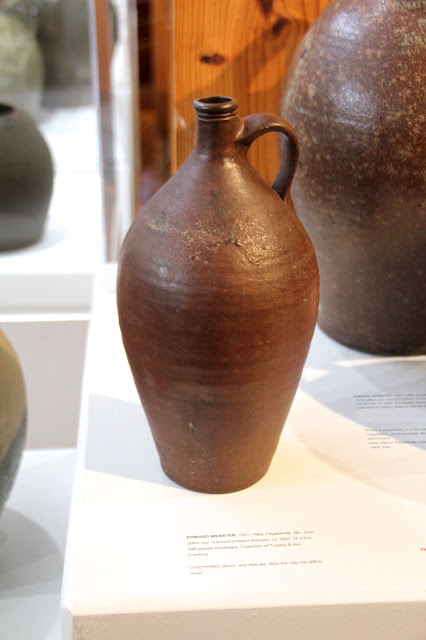
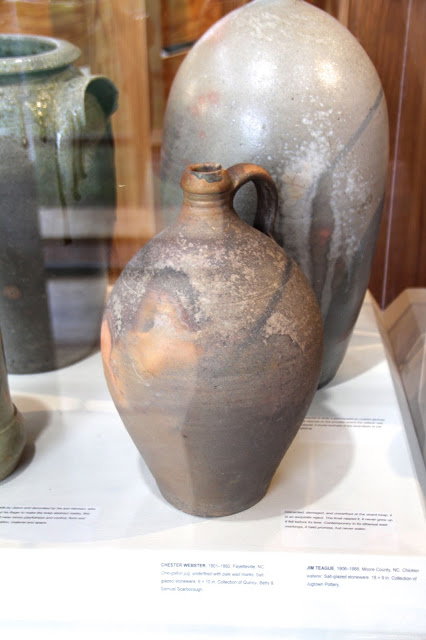
I really like this Chester Webster jug too: despite being underfired, it has a lot going on in the surface. I like shape of the the neck and lip too.
Alkaline Glazed Stoneware (NC)
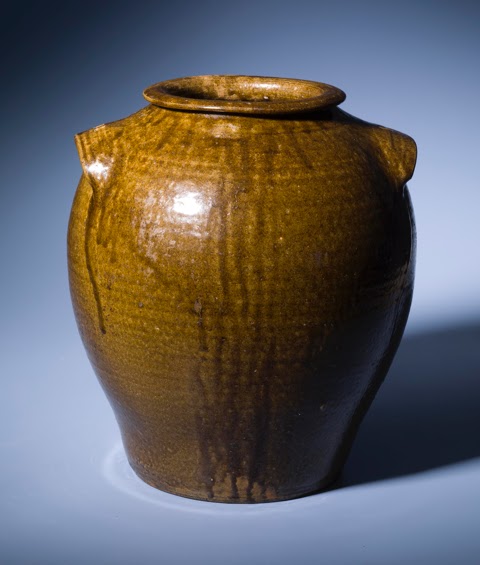
DANIEL SEAGLE, ca 1805–1867, Lincoln County, NC. Fifteen-gallon jar. Alkaline-glazed stoneware. 18 × 19 in. Collection of Quincy, Betty & Samuel Scarborough.
Orthodox, generous, and calm, with somber notes, Daniel Seagle’s giant pot possesses an accuracy and girth that set a standard.
DANIEL SEAGLE, ca 1805–1867, Lincoln County, NC. Five-gallon jar. Alkaline-glazed stoneware. 16 × 13 in. Collection of Danny Richard.
Pottery collector Danny Richard got a call from someone in Lincoln County saying they’d found old pots buried under their house. They knew he was interested. Covered in dirt, a pig in a poke, he paid the price. All except one looked cracked or broken. He put them in his pickup, drove away, then stopped by a creek, took them to the water, and used his shirt to wash away the dirt. This one was baptized intact.
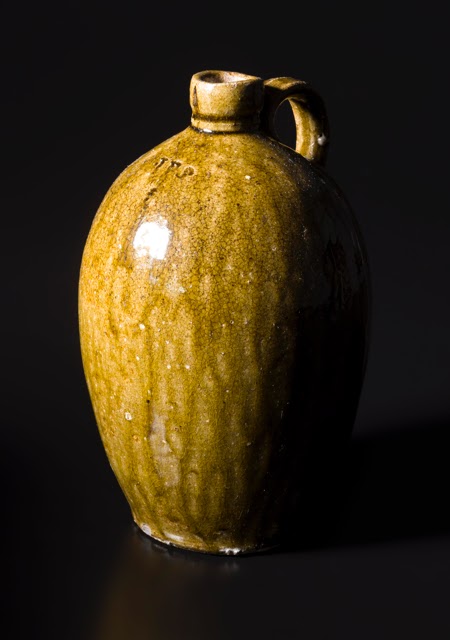
JAMES FRANKLIN SEAGLE, 1829–1892, Lincoln County, NC. Half-gallon jug. Alkaline-glazed stoneware. 9½ × 6 in. Collection of Scott & Wendy Smith.
Another talented Seagle, Daniel’s son James Franklin, precise, disciplined, carrying on where his father left off. Different times though, the pre– and post–Civil War South.
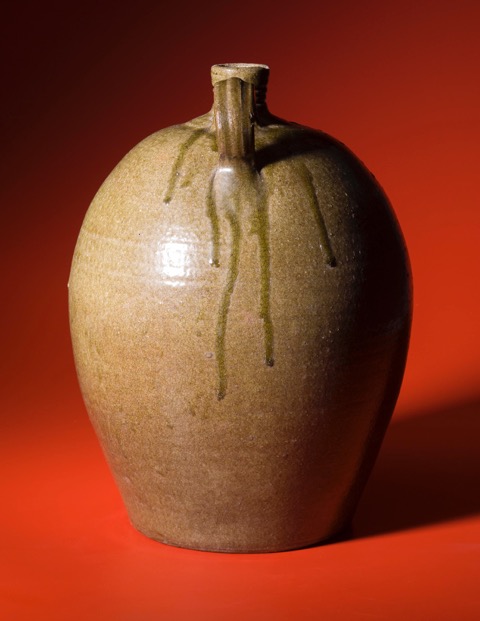
ISAAC LEFEVERS, 1831–1864, Lincoln County, NC. Five-gallon jug. Alkaline-glazed stoneware. 18 × 13 in. Collection of Quincy, Betty & Samuel Scarborough.
IL: tragically rare letters. The orphaned apprentice who died at thirty-three. The stick figure–like drips, from excess glaze tipped back after the pot was dunked, are deliberate. If you pay attention, control of process generates ornament.
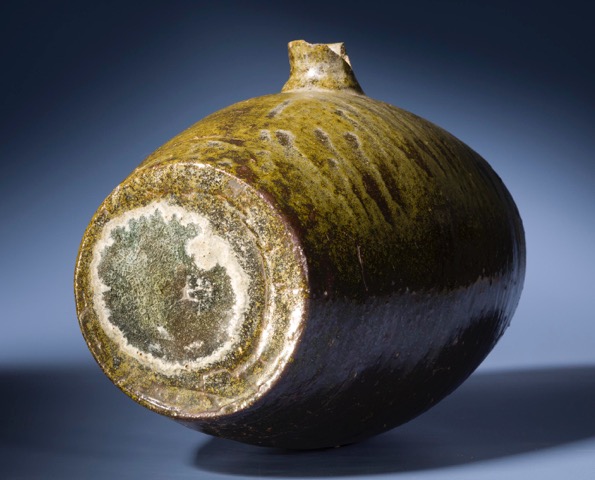
SYLVANUS HARTSOE, 1850–1926, Lincoln County, NC. Large rundlet with glass melt. Alkaline-glazed stoneware. 13 × 18 in. Collection of Allan & Barry Huffman.
A submarine or a “medicine” bottle? Glaze application drips and a pool of glass give a liquid air to this curious container.
UNKNOWN MAKER, Lincoln County, NC. Five-gallon jar with glass runs, ca 1875. Alkaline-glazed stoneware. 16¼ × 13 in. Collection of Scott & Wendy Smith.
Moore and Randolph County (NC) Salt Glaze
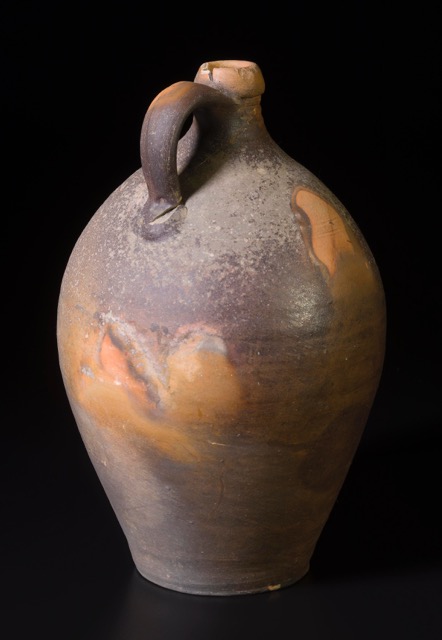
CHESTER WEBSTER, 1801–1882, Fayetteville, NC. One-gallon jug, underfired with pale wad marks. Salt-glazed stoneware. 6 × 10 in. Collection of Quincy, Betty & Samuel Scarborough.
Discarded, damaged, and unearthed at the shard heap, it is an exquisite reject. The frost nipped it, it never grew up, it fell before its time. Contemporary in its ethereal wad markings, it held promise, but never water.
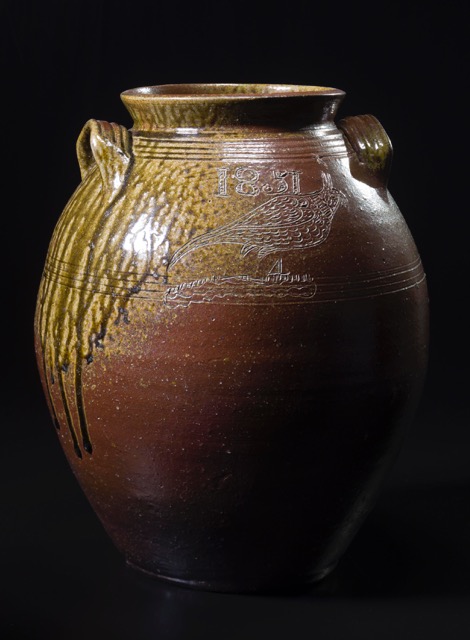
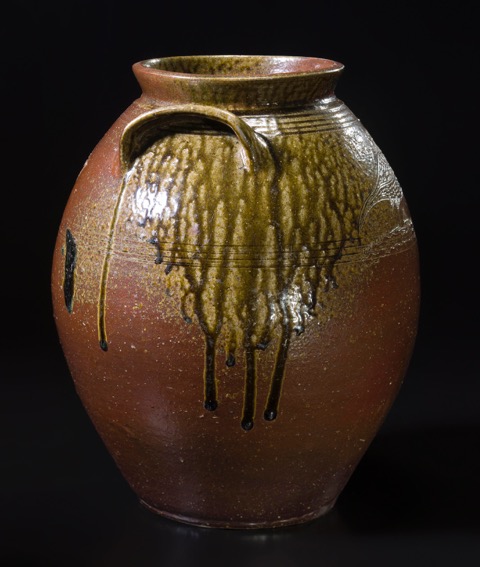
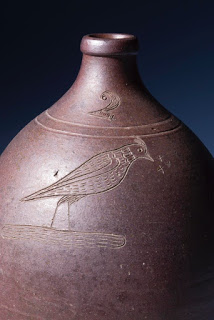
CHESTER WEBSTER, 1799-1882, Randolph County, NC. Three-gallon jar with incised bird, fish, and date, 1851. Salt-glazed stoneware. 15 × 12 in. Collection of Tommy & Ann Cranford.
A whimsical bird plucks a fly from the date-filled air, while a fish pirouettes behind. Chester’s humor didn’t fester.
CHESTER WEBSTER, 1799–1882, Randolph County, NC. Two-gallon jug, with incised bird. Salt-glazed stoneware. 15 × 9 in. Collection of Quincy, Betty & Samuel Scarborough.
A perfectly poised profile rewarded with a trilling bird, or is it catching flies? Either way it’s smiling.
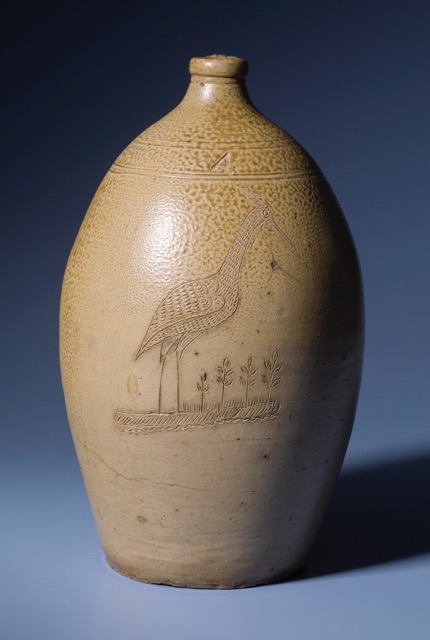
CHESTER WEBSTER, 1799–1882, Randolph County, NC. Four-gallon jug, with incised heron. 18 × 10 in. Collection of Tommy & Ann Cranford.
Webster incised herons, Cardew painted them. One flew overhead when I first stood where my chimney would be.
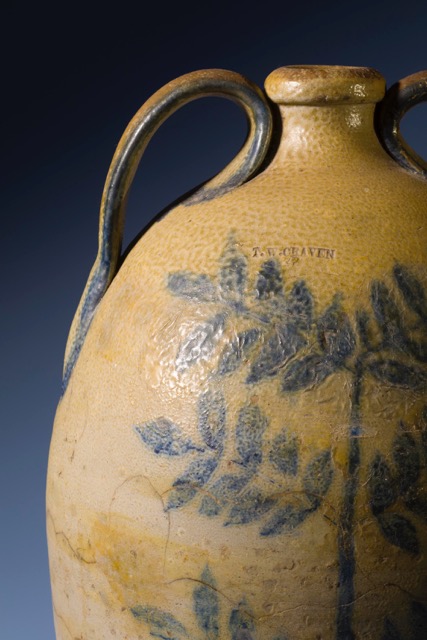
T. W. CRAVEN, 1829–1858, Randolph County, NC. Ten-gallon double-handled jug, with cobalt sumac tree. Salt-glazed stoneware. 21 × 14 in. Collection of Quincy, Betty & Samuel Scarborough.
Bewitched, bothered, and bewildered, this captivating beauty was damaged, perhaps by frost, and crudely repaired with epoxy. There’s no hiding loveliness, though.
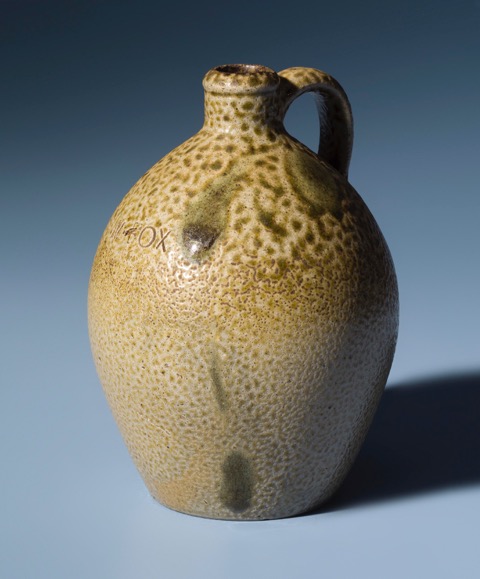
NICHOLAS FOX, 1797–1858, Chatham County, NC. Half-gallon jug, with kiln drips. Salt-glazed stoneware. 7 × 6 in. Collection of William Ivey.
A sweet shape with juicy drips and luscious ash.
J. J. OWEN, 1830–1905, Moore County, NC. Two-gallon patent jar. Salt-glazed stoneware. 17 × 10 in. Collection of Jugtown Pottery.
Beaten, broken, maybe even shot, this jar is an invalid. Dignified nonetheless by its spectacular tonal variation, its hole is a badge of honor for years of service.
J. H. OWEN, 1866–1923, Moore County, NC. Drain tile. Salt-glazed stoneware. 15 × 7 in. Collection of Jugtown Pottery.
A piece of minimalist abstract art? It depends on the context.
TEAGUE FAMILY, Randolph County, NC. Grave Marker for James R. Teague, 1938. Salt-glazed stoneware. Gift of Charles G. Zug III, Ackland Art Museum, University of North Carolina at Chapel Hill. 84.42.1. (Photographs by Scott Richard Hankins).
This one gives me the shivers.
Alamance County (NC) Salt Glaze
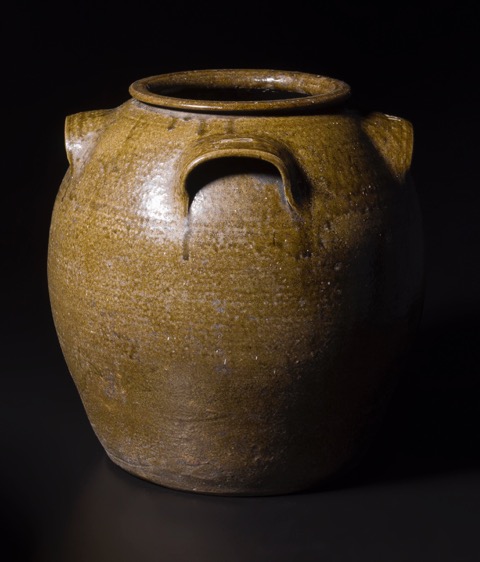
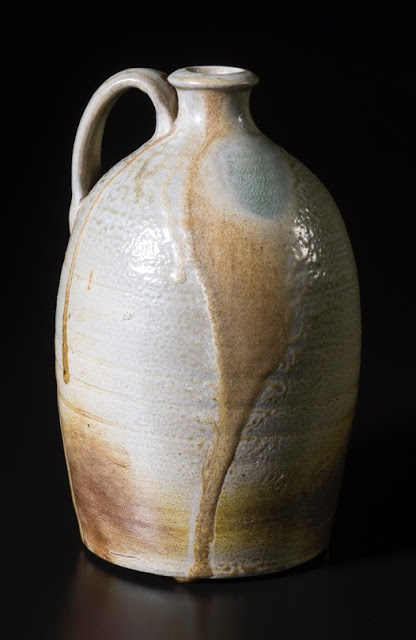
SOLOMON LOY, 1805–ca 1860, Alamance County, NC. One-and-a-half-gallon pitcher with ash runs and kiln drips. Salt-glazed stoneware. 11½ × 9 in. Collection of Robert & Jimmi Hodgin.
Its shape is stiff and squat, but its delicately pinched throat and spout combine with the glistening ash runs and a diaphanous kiln drip to make it spectacular.
SOLOMON LOY, 1805–ca 1860, Alamance County, NC. One-gallon jug with ash runs and kiln drips. Salt-glazed stoneware. 11 × 7 in. Collection of Robert & Jimmi Hodgin.
Add more colors to the mix, and here’s another wonder. Dark patches from salt shadows and a swath of slow-cooled ash distinguish this treasure.
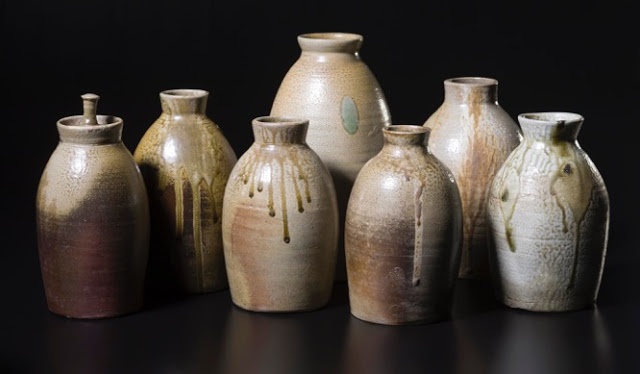
GROUP OF CANNING JARS
Sleek, narrow-mouthed, and infinitely varied, these stunning canning jars are unique to Alamance County. Like leaves they shimmer and glow, all dappled and drippy, set up for a show.
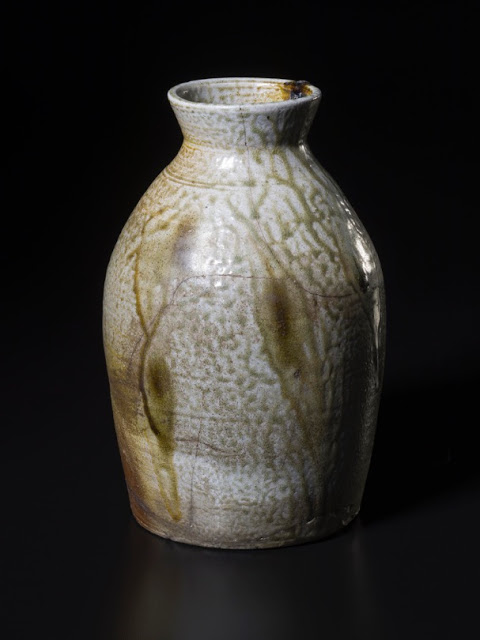
TIMOTHY BOGGS, 1849–ca 1910, Alamance County, NC. Canning jar. Salt-glazed stoneware. 11 × 7½ in. Collection of Robert & Jimmi Hodgin.
Humpty Dumpty had a great fall, but didn’t quite break. Injured but not discarded, no longer useful but valuable nonetheless. An exotic, wild, damaged beauty, treasured despite its flaws, for its flaws.
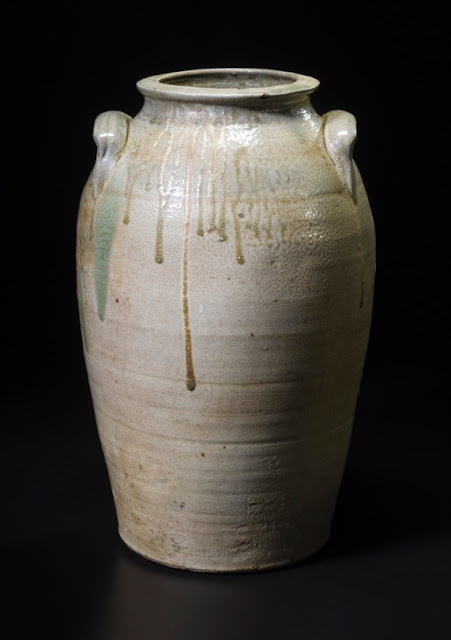
SOLOMON LOY, 1805–ca 1860, Alamance County, NC. Eight-gallon jar. Salt-glazed stoneware. 20 × 12 in. Collection of Joseph & Amanda Sand.
Of all the potters in the South, Solomon Loy seems to have deliberately composed the abstract appearance of his stoneware pots, artfully finessing the process of salt firing, with its accompanying kiln drips and ash runs, and consciously layering seductive colors and enigmatic textures.
SOLOMON LOY, 1805–ca 1860, Alamance County, NC. Ten-gallon jar with ash runs and kiln drips, stamped “S. LOY 1856 10.” Salt-glazed stoneware. 19 × 14 in. Collection of Robert & Jimmi Hodgin.
An amputee, with stumps where its handles used to be, this big jar remains magnificent, proud, and undaunted.
Earthenware from North Carolina
JACOB WEAVER II, 1774–1846, Catawba County, NC. Plate, ca 1790. Lead-glazed earthenware. 4 × 9 1/2 in. Collection of Tommy & Ann Cranford.
Unlike most of the early earthenware potters in North Carolina, who worked in the eastern Piedmont, Jacob Weaver built his kiln in Catawba County, known primarily for its later alkaline-glaze tradition. This kiln site and plate were only recently discovered. Simple, controlled, and lively, the plate has a beautifully executed set of polychrome slip-trailed lines with sgraffitoed rim decoration. Incredibly, it has remained in perfect condition since the 1790s.
SOLOMON LOY, 1805– ca 1860, St. Asaph’s tradition, Alamance County, NC. Small plate, ca 1820–1840. Lead-glazed earthenware. 2 × 6½ in. Collection of Robert & Jimmi Hodgin.
Fleshy pink blotches with black and white dots. A straightforward description says little about the wonders of this masterpiece. Warm and embraceable, with a cloudy gray quadrant where the smoke choked the gritty clay into soft, blushing halos. Dots float along the surface like confetti.
Attributed to WILLIAM DENNIS New Salem Quakers, Randolph County, NC. Plate, ca 1800. Lead-glazed earthenware. 2¼ × 10¾ in. Collection of Stephen C. Compton.
An autumnal mood resides in the fernlike decoration and deciduously swaging border of this plate. Its character marks the reliability of the cyclical rhythm of the seasons.
SOLOMON LOY, 1805–ca 1860, St. Asaph’s tradition, Alamance County, NC. Miniature mug, ca 1820–1840. Lead-glazed earthenware. 2½ × 3½ in. Collection of Tommy & Ann Cranford.
One can only imagine the delight a youngster would have using this sweet spattered mug, or entertaining with it as part of a doll’s tea set. Childs play, imaginative and unbroken.
Pots from South Carolina
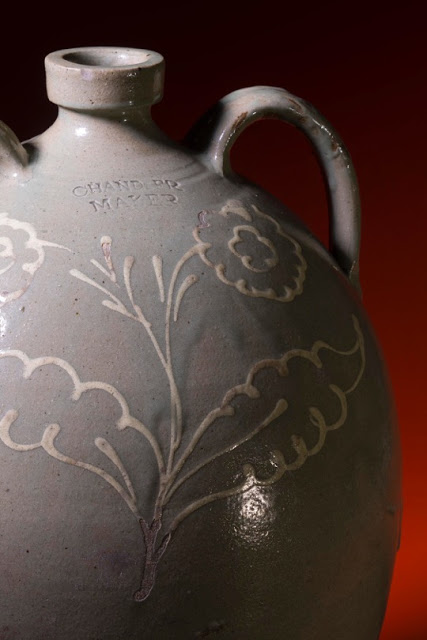
THOMAS CHANDLER, 1810–1854, Thomas Chandler Stoneware Factory, Kirksey’s Crossroads, Edgefield District, SC.Double-handled five-gallon jug with slip-trailed floral motif, stamped “CHANDLER MAKER,” ca 1850. Alkaline-glazed stoneware. 19 × 11 in. Collection of David Ward.
Soft color on strong form while the decoration sits perfectly on the shoulder. Big blue celadon, calm and authoritative.
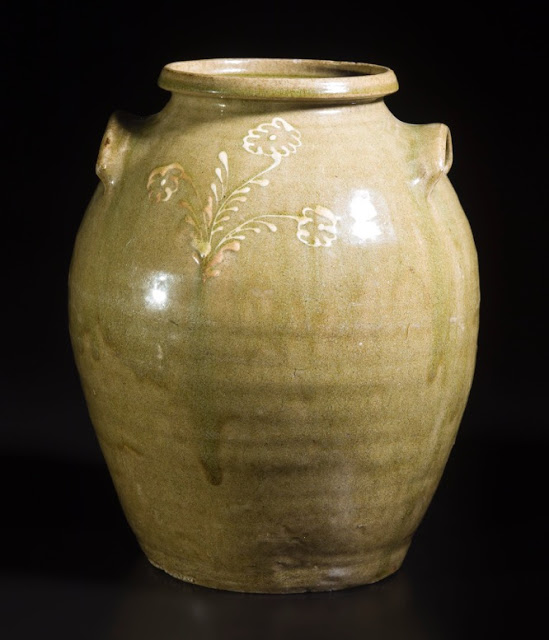
THOMAS CHANDLER, 1810–1854, C. Rhodes Factory, Shaw’s Creek, Edgefield District, SC. Three-gallon jar with slip-trailed floral motif, ca 1850. Alkaline-glazed stoneware. 15 × 11 in. Collection of Jim Witkowski.
The shape is superb, the handles snug, and flowers flow — alive, deftly drawn. A different performance on each side, all bathed in luxuriant celadon, the perfect tone. Layer upon layer of slightly changing excellence, Chandler’s repeated themes and variations resemble a fugue.
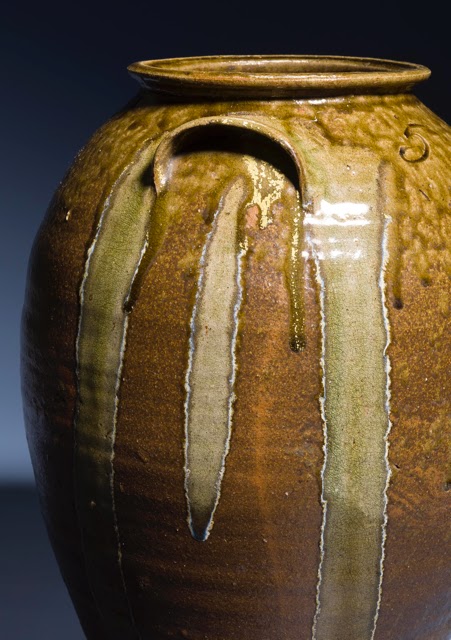
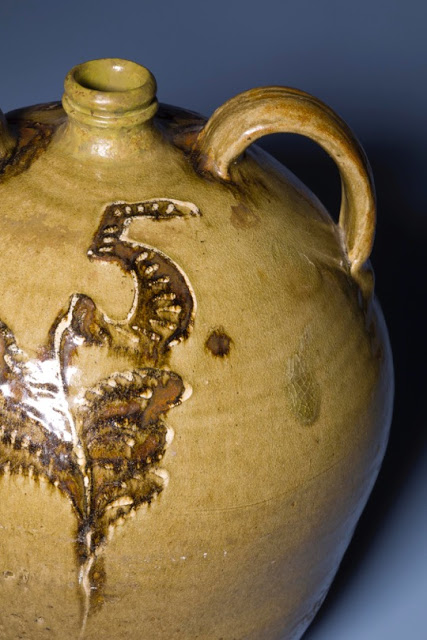
UNKNOWN MAKER, C. Rhodes Factory, Shaw’s Creek, Edgefield District, SC. Five-gallon Jar, slip-decorated with a “number flower” on one side and a flower on the other, ca 1850. Alkaline-glazed stoneware (with repaired neck). 14½ × 12 in. Collection of John LaFoy.
Does a repair ruin a pot? Is such a flaw acceptable in an exhibition? The rest of the pot is fabulous, the “5” flower (the rare Rhodesian genus flora numerica), with a second exotic on its rear. But that green neck? Probably done with great care in the 1960s by someone who should have known better, it’s like a blemish on a pretty forehead.
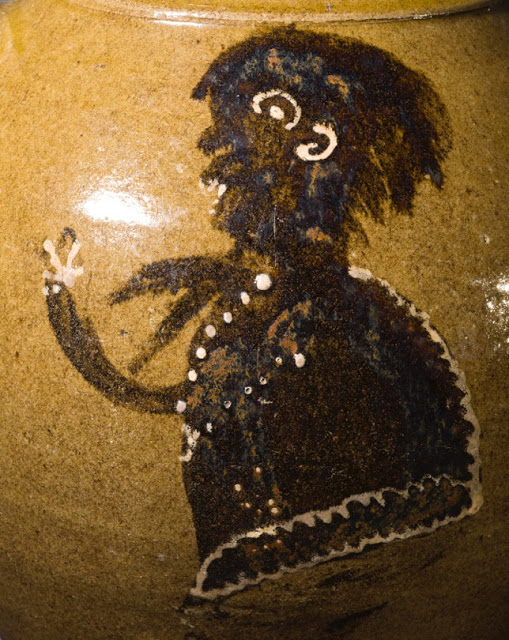
UNKNOWN MAKER, C. Rhodes Factory, Shaw’s Creek, Edgefield District, SC. Three-gallon jar, slip-decorated with the profile of a man on one side and a flower on the other, ca 1840. Alkaline-glazed stoneware. 14½ × 12 in. Collection of John LaFoy.
The slip was dark, the figure’s race unclear. A person in profile with hair, an eye, an ear, teeth, a kerchief, buttons, frills, and fingers, warm ochre red bleeding through the glaze. A complex moment recorded. A life.
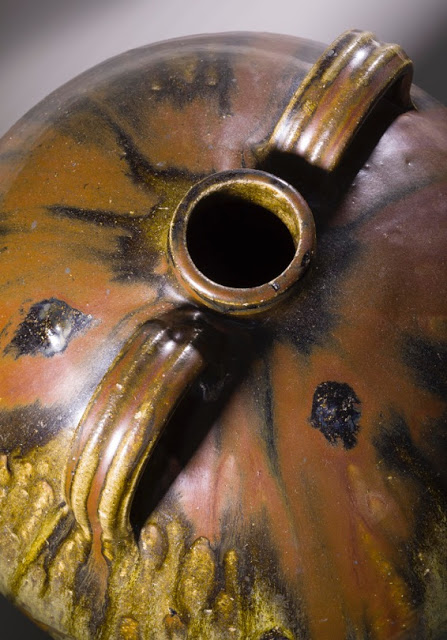
UNKNOWN MAKER, Upstate South Carolina, or Thomas Chandler School, Martintown Road Pottery, Kirksey’s Crossroads, Edgefield District, SC, or John D. Leopard, Bacon Level, Randolph County, Alabama. Ten-gallon double-handled jug, with red ochre bleeds and residual ochre nuggets. Alkaline-glazed stoneware. 20 × 14 in. Collection of David Ward.
UNKNOWN MAKER, Upstate South Carolina, or Thomas Chandler School, Martintown Road Pottery, Kirksey’s Crossroads, Edgefield District, SC, or John D. Leopard, Bacon Level, Randolph County, Alabama. Ten-gallon double-handled jug, with red ochre bleeds and residual ochre nuggets. Alkaline-glazed stoneware. 20 × 14 in. Collection of David Ward.
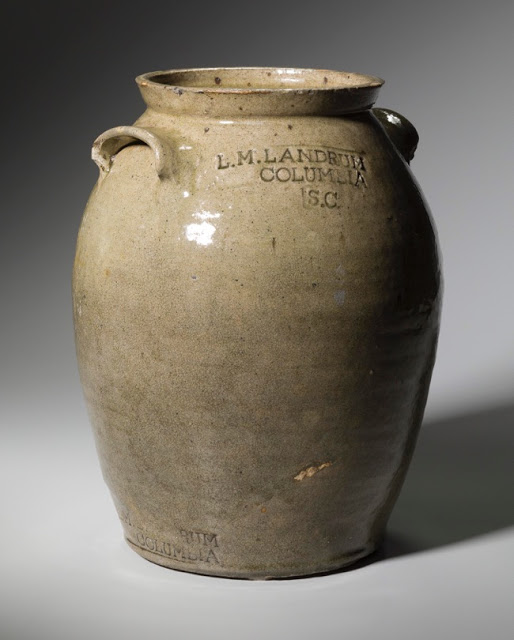
LINNAEUS LANDRUM, ca 1829–1891, Landrum Pottery, Eight Mile Branch, Columbia, SC. Three-gallon jar with feldspar glaze, stamped twice “L.M. Landrum, Columbia S.C.,” ca 1860. Alkaline-glazed stoneware. 15½ × 11½ in. Study collection of Philip & Deborah Wingard.
Maybe it’s the crazing, the color, the shape, or the feeling it conveys? Somehow the gray-green, silky soft patina and sweet shape make this one an absolute winner.
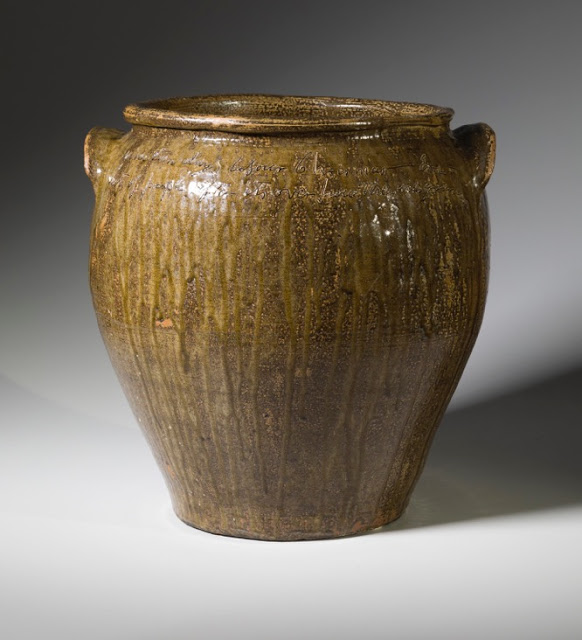
DAVID DRAKE, ca 1800–1870, Lewis Miles Pottery, Horse Creek, Edgefield, SC. Twenty-gallon jar inscribed, “Nineteen days before Chrismas Eve — Lots of people after its over, how they will greave . . . LM, Dave, Dec 6 1858.” Alkaline-glazed stoneware. 21 × 19½ in. Collection of Corbett Neal Toussaint.
Dave Drake’s verse haunts, as do others on his pots. Some of them express resistance in the slave South. This one, for instance, may refer to the grim practice of giving slaves to a new owner as a Christmas present, or of leasing enslaved laborers to other area slaveholders for one-year stints, starting on New Year’s Day. Good tidings on Christ’s birthday? Joy, peace, love… and families torn apart? The enslaved potter Dave Drake exposes their grief and suffering through his hands, intellect, and voice. Drake was taught to read and write---a star that was allowed to shine, while others were not.
Let there be light!
Kiln Opening at Mark Hewitt's Pottery, Firing Elle, Spring 2017.
The pottery looked as clean and ship-shape as I have ever seen it by the time people arrived on Saturday morning. It was a lovely day and a good crowd showed up early; there was a line by the time I arrived.
The firing went well -- we've been continuing to experiment with glazes, in particular the celadons based on this Salisbury pink granite which Mark collected from a local quarry. We've been focusing on trying to make it craze less as a bisque glaze (with high percentage of the granite) and developing raw glazes with it that still look attractive. Still some refining to do but we're definitely getting closer, and we're pleased with how many of the pots came out. I plan to do a post with our findings and test results in more detail some time this spring.
There are still plenty of pots left for next weekend; we saved some to put out fresh.
Saturday April 29, 9 - 5pm, and Sunday April 30, 12pm - 5pm.
 |
| Mark addressing the congregation early Saturday morning. |
 |
| People flow down to the barn. |
We lined Mark's big pots up this time, rather than having them in the round. I think they look great down in the field like this.
 |
| Big pots. Monumental pecan tree in the background. |
 |
| Mark Hewitt, Big Pots. Spring 2017. |
 |
| Mark Hewitt, Bloom. Large stoneware vase. $4,500. |
 |
| Mark Hewitt, Tears for America. Large ash glazed stoneware jar. Spring, 2017. $12,000. |
 |
| Close up of Tears for America. |
 |
| Mark Hewitt, Pirouette. Large celadon stoneware vase. Spring, 2017. $9,500. |
 |
| Mark Hewitt, The Raver. Large ash glaze stoneware vase. Spring, 2017. $9,500. |
 |
| One lady getting up close and personal with The Raver. |
 |
| Close up of Raver. |
 |
| Mark Hewitt, Wiggle Waggle. Large celadon stoneware vase. Spring, 2017. $6,500. |
 |
| Close up of Wiggle Waggle. |
 |
| Mark Hewitt, Into the Night. Large tenmoku stoneware vase. Spring, 2017. $6,500. |
 |
| Close up of the glass drips on Into the Night. |
 |
| Mark Hewitt, Black Eye. Large salt-fired stoneware vase. $5,000. |
 |
| Close up of Black Eye. |
Into the barn...
 |
| The roses are out in force. |
 |
| Mark Hewitt, Platter and ice cream bowls. Spring, 2017. |
 |
| Mark Hewitt, Pitcher and barrel mug. Spring, 2017. |
 |
| Mark Hewitt, Ginger Jar. Spring, 2017. |
 |
| Mark Hewitt, Vases. Spring, 2017. |
 |
| Mark Hewitt, Gravemarkers. Spring, 2017. |
 |
| Mark Hewitt, Two Part Vase. Spring, 2017. |
 |
| Mark's little blurb for this last cycle. |
 |
| Mark Hewitt, Two Part Vase. Spring, 2017. |
 |
| Mark Hewitt, Iced Tea Tumblers. Spring 2017. |
 |
| Mark Hewitt, Ginger Jar. Spring, 2017. |
 |
| Mark Hewitt, Ginger Jar. Spring, 2017. |
 |
| A couple happy with the ginger jar they had picked up. |
 |
| Mark Hewitt, Ginger Jar. Spring, 2017 |
 |
| Mark Hewitt, Umbrella Pot and Mug. Spring, 2017. |
 |
| Mark Hewitt, Various Pots, Spring 2017. |
 |
| Mark Hewitt, 10 Gallon Pots (and a few mugs). Spring, 2017. |
 |
| Will they all fit? |
Here's a couple of pics a mix of Stilly and I's pots on the shelves, just before the customers got into them:
 |
Blue celadons on the top, green celadons in the middle, and tenmoku on the bottom shelf. |
Now a smattering of Stillman's pots...
 |
| Stillman Browning-Howe, Various Pot. Spring, 2017. |
 |
| Stillman Browning-Howe, Tankards. Spring, 2017. |
 |
| Stilly's blurb. |
 |
| Stillman Browning-Howe, Bud Vases. Spring, 2017. |
 |
| A couple checking out one of Stillman's jars. |
Lastly, some of mine...
 |
| Hamish Jackson, Various Pots. Spring, 2017. |
 |
| Hamish Jackson, Wall Vases. Spring, 2017. |
 |
| Hamish Jackson, Wall Vases. Spring, 2017. |
 |
| Hamish Jackson, Souffle Dish. Spring, 2017. |
 |
| Hamish Jackson, Teapot. Spring, 2017. |
 |
| Hamish Jackson, Canister Jar. Spring, 2017. |
 |
| Hamish Jackson, Two Part Vase. Spring, 2017. |
 |
| Hamish Jackson, Canister Jar and Cruets. Spring, 2017. |
 |
| Hamish Jackson, Small and Large Cruets. Spring, 2017. |
I took some of my favorites at home with a Flotone backdrop:
 |
| Hamish Jackson, Celadon Bud Vase. Spring, 2017. Sgraffito under blue celadon glaze. |
 |
| Hamish Jackson, Small Footed Bowl. Spring, 2017. Red slip with white and red slip dots applied when wet and moved around to create this marbled effect. |
 |
| Hamish Jackson, Barrel Mug. Spring, 2017. White slip dots under green celadon glaze. |
 |
| Hamish Jackson, Tea Tumblers. Spring, 2017. Red and white slip trailing under blue celadon glaze. |
 |
| Hamish Jackson, Creamer. Spring, 2017. White slip circles and red slip dots. I love how clean and translucent this glaze came out. |
 |
| Hamish Jackson, Souffle Dish. Spring, 2017. From the front stack of the kiln: it got a lot of ash hitting the surface. |
 |
| Hamish Jackson, Large tenmoku teapot. Spring, 2017. Red and white slip under tenmoku. |
 |
| Hamish Jackson, Family sized celadon teapot. Spring, 2017. Brushed red slip and white slip dots under green celadon glaze. |
 |
| Hamish Jackson, Family sized tenmoku teapot. Spring, 2017. This was fired on the floor of chamber two, at the foot of the big pots. |
 |
| Hamish Jackson, Yunomi. Spring, 2017. Shino with red iron oxide over the top, wood ash collected on rim. |
 |
| Hamish Jackson, Pair of celadon cruets. Spring, 2017.Sgraffito under two different celadons. |
 |
| Hamish Jackson, Celadon cider jar. Spring, 2017.White and red slip trailing under green celadon glaze. |
 |
| Hamish Jackson, Shino cider jar. Spring, 2017.Fired in the front stack but protected by a bag wall; the surface up close is luminescent and sparkles green and blue. |
 |
| Hamish Jackson, Quart pitcher. Spring, 2017.Blue glass under celadon with bone ash addition. We only got these red drips on a few pots -- not really sure why. |
 |
| Hamish Jackson, Shino soy dishes. Spring, 2017.Red iron oxide under shino. |
 |
| Hamish Jackson, Canister Jar. Spring, 2017.Brushed shino glaze and wood ash (this one was buried in wood ash next to a stoke hole). |
 |
| Hamish Jackson, Canister Jar. Spring, 2017.Red and white slip trailing under green celadon glaze. |
 |
| Hamish Jackson, Canister Jar. Spring, 2017.Red and white slip trailing under tenmoku glaze. |
 |
| Hamish Jackson, Yunomi. Spring, 2017. Red iron oxide under green celadon glaze: front stack. I don't know why but this glaze has such a silky soft feel to it. |
NCECA In Review: Portland 2017. Concurrent Wood Firing Exhibitions: Ashes & Flux and Great Waves Over the Pacific.
These two wood firing exhibitions were held concurrently in the Chehalem Cultural Centre in Newberg, Oregon. Wood-fired pottery is what I am practicing and love, so I was especially excited to see these shows. The Chehalem Centre was a bit of a drive outside Portland, but we hooked up with some old friends and ate at a fantastic Korean market on the way.
In the interest of good record-keeping, I have written out the labels on the pieces as they were in the exhibitions, including their prices. I've also included links to the artists' websites where I could find them.


Central to this blossoming tradition is the East Creek Anagama. This was the first anagama kiln built in the U.S. west of the Mississippi. The project was started by Nils Lou, Frank Boydon, and Tom Coleman approximately 32 years ago. It was based on an eighth century Korean kiln. Made of over 5,000 hand cut bricks, it measures about 16 feet long, 6 wide, and 5 tall. Many students have come to help prepare for firings and take shifts firing the kiln. It was East Creek that spawned the other three anagama kilns included in this exhibition. I'll show the pots from East Creek first though.


Completed in 2004, the Noble Hill anagama was built (on a Christmas Tree farm) by Mark Terry. He was inspired to build his own anagama by years of firing at East Creek. It is only about 120 cubic feet (about a third of the size of East Creek's kiln). In its 13 years of use, Terry's kiln has been fired more than 60 times and served to introduce many young potters to wood firing.


The FuuKooGama was designed, owned and operated by Ruri. It was modified/built with help from Yoshiyuki Ito, Mashiko. The main aim was to vitrify the pots without any slip or glaze or really any form of surface manipulation. FuuKooGama means "Wind and Light Kiln" (Foo means wind and Koo means light). She describes in her video interview (linked below) that often you cannot see wind or light, but can feel it: Ruri tries to express something she cannot see through clay that is transformed in her kiln. This definitely ties in to Takashi Nakazato's teaching. As well as the below pictures, all of Ruri's work on display in the Waves exhibition was anagama fired for seven days in the FuuKooGama.
There is a great video on youtube about Ruri and her work, especially discussing building and firing the FuuKooGama. This is part 1 of 2: https://www.youtube.com/watch?v=ub8FUqj5lgY
I particularly enjoyed how she talks about the flame in the kiln moving like a mountain stream; speeding up where pieces are closely packed and causing flashing effects.


Some of my favorite pots from Ashes & Flux came out of Pleasant Hill. It was started in 2000 by Tom Rohr and Kathryn Finnerty, but has since been taken over by Jesse Jones and Lauren Sommers. They have four wood kilns now. The first was built in 2001; a 60 cubic foot two-chambered wood, biodiesel, salt kiln-named 'Pepino.' Next came a 110 cubic foot anagama, named 'Tomogama,' in 2007. Then they added a wood/biodiesel soda kiln in 2014 and finally a small wood/biodiesel train kiln was built in 2014.


As you can tell, I liked these plates a lot. Amazing silky flashed surfaces. Jesse told me that the plates were unglazed and unslipped going in the kiln; made using a g-mix... a clay mixed by a local company called Georgies. They were fired in the anagama close to the floor, about 18" off the face, in a stack of four with about an inch in between each plate.


This exhibition reminded me how large wood kilns such as these can bring people together and foster learning experiences outside of formal college environs. I think it could be an interesting model to consider when I build a kiln of my own. Having additional people to help prepare all the wood, grind the kiln shelves, load, and fire must be pretty nice too!
Well I think that's all for now. Wish we had had time to go out and visit these kilns. Next time!
In the interest of good record-keeping, I have written out the labels on the pieces as they were in the exhibitions, including their prices. I've also included links to the artists' websites where I could find them.
Great Waves Over the Pacific: On Wood Firing. (March 7 - March 25, 2017)
This exhibition focused on the influence of the artist Takashi Nakazato's influence on Japanese and American ceramics. Nakazato travelled widely around the Pacific learning and sharing methods of making. Takashi was born into a pottery family. His father was the twelfth in line of a long line of masters in the Nakazato family. They are the most eminent family in Karatsu, whose name has become synonymous with pottery.
Takashi has pushed the traditions of his family, creating ceramics with a new vitality; he uses the term 'Karatsu Nanban' to describe his style. 'Nanban' refers to unglazed pottery which had long been made in other parts of Asia, such as Southern China, but never Japan until the sixteenth century. His influence in America has been in aiding the spread of wood firing unglazed work, especially in anagama kilns. The artist Ruri organised this show around these principals. Ruri fired the FuuKooGama, which she owns and operates, before the conference started with guest artists John Neely, Doug Casebeer and Chris Gustin. Wish I could have come out to see it in action!
I did not photograph every piece (should have in retrospect) but here is a smattering...
View from afar.
Flow, Ruri. Anagama fired stoneware. $900.
Close-up of the above piece. I love the soft satin surface of these pots.
Just Like a Drop of Rain, Ruri. Anagama fired stoneware. $1900.
Buena Vista Vase, Brad McLemore. Ceramics. $95.
Tea Bowl 2, John Neely. Wood-fired stoneware. $400.
Kaiseki for Two, Collaboration between Takeshi Nakazato, Fumiko Nagai and Ruri. Wood fired stoneware.
Small plate with wadding pattern, Fumiko Nagai, and Chop stick stands by Ruri.
Close up of Nagai's small plate with wadding pattern.
Square Platter, Brad McLemore. $175.
Bardo, Ruri. Anagama fired stoneware. $900.
Considering Ruri's hanging sculpture. Photo credit: Brad Yazzolino
Gustin's gourd and I, getting intimate. Photo credit: Brad Yazzolino
Ashes & Flux. (March 7th - 25, 2017)
This exhibition was in the same gallery space as the Great Waves show, and the transition was easy. Ashes & Flux represents the wood-fired pottery of the North West. It concentrated on the work coming out of four anagama stye kilns: East Creek, Noble Hill, Pleasant Hill, and the FuuKooGama.
The four kilns represented with a bit of info on each.
Central to this blossoming tradition is the East Creek Anagama. This was the first anagama kiln built in the U.S. west of the Mississippi. The project was started by Nils Lou, Frank Boydon, and Tom Coleman approximately 32 years ago. It was based on an eighth century Korean kiln. Made of over 5,000 hand cut bricks, it measures about 16 feet long, 6 wide, and 5 tall. Many students have come to help prepare for firings and take shifts firing the kiln. It was East Creek that spawned the other three anagama kilns included in this exhibition. I'll show the pots from East Creek first though.
Red Barron Flying Ace, Andrew Butterfield. East Creek. $80.
In front: Gourd 3, Lori Allen. East Creek. $350.
Behind: Funky Bottle, Lew Allen. East Creek. NFS.
Sculpture #2, Don Haskisson. East Creek. $320.
Whiskey Bottle with Tomobako, Joe Robinson. East Creek. $195.
Hammered Jar, Lew Allen. East Creek. $120.
The Better to Smell You With, Andrew Butterfield. East Creek. $75.
Cut of the Same Cloth, Mya Haskisson. East Creek. $200.
Cut of the Same Cloth, Mya Haskisson. East Creek. $200.
Steeler, Mike Helle. East Creek. $450.
I love this fish.
Steeler, Mike Helle. East Creek. $450.
Jar with Lugs, Joe Robinson. East Creek. $975.
Gourd 2, Lori Allen. East Creek. $350.
40lb Jar, Joe Robinson. East Creek. $1850.
Completed in 2004, the Noble Hill anagama was built (on a Christmas Tree farm) by Mark Terry. He was inspired to build his own anagama by years of firing at East Creek. It is only about 120 cubic feet (about a third of the size of East Creek's kiln). In its 13 years of use, Terry's kiln has been fired more than 60 times and served to introduce many young potters to wood firing.
Ariadne, Mark Terry. Noble Hill. $2800.
Bottle, Amy Burnham. Noble Hill. NFS.
Bottles, Amy LeFever. Noble Hill. NFS.
Drip Vase, Jim Busby. Noble Hill. NFS.
Drip Vase, Jim Busby. Noble Hill. NFS.
Whiskey Vase, Amy Burnham. Noble Hill. NFS.
Stoneware Teapot, Burk Kielber. Noble Hill. $350.
Stoneware Teapot, Burk Kielber. Noble Hill. $375.
Jar, Jim Busby. Noble Hill. NFS.
There is a great video on youtube about Ruri and her work, especially discussing building and firing the FuuKooGama. This is part 1 of 2: https://www.youtube.com/watch?v=ub8FUqj5lgY
I particularly enjoyed how she talks about the flame in the kiln moving like a mountain stream; speeding up where pieces are closely packed and causing flashing effects.
Long-necked Vase, Nathan Paddock, FuuKooGama.
Large Bottle, Brad McLemore. FuuKooGama. $200.
Conversation II (Diptych), Ruri & Brad McLemore. FuuKooGama. $200.
Pitcher, Spencer Dixon. Pleasant Hill. $250. (Fired in the train kiln).
Pitcher, Spencer Dixon. Pleasant Hill. $250.
Wall Hanging Plates, Jesse Jones, Pleasant Hill, $450/set. Anagama fired.
Wall Hanging Plates, Jesse Jones, Pleasant Hill, $450/set. Anagama fired.
Wall Hanging Plates, Jesse Jones, Pleasant Hill, $450/set. Anagama fired.
Wall Hanging Plates, Jesse Jones, Pleasant Hill, $450/set. Anagama fired.
As you can tell, I liked these plates a lot. Amazing silky flashed surfaces. Jesse told me that the plates were unglazed and unslipped going in the kiln; made using a g-mix... a clay mixed by a local company called Georgies. They were fired in the anagama close to the floor, about 18" off the face, in a stack of four with about an inch in between each plate.
Wall Hanging Plates, Jesse Jones, Pleasant Hill, $450/set. Anagama fired.
Vase, Richard Brandt. Pleasant Hill. $450. Anagama fired.
Gongfu Cha Set, Jonathan Steele. Pleasant Hill. $200.
Cast Solo Cups, Jesse Jones. Pleasant Hill. Anagama fired.
Sipping Set, Barb Campbell. Pleasant Hill. $300. Anagama fired.
Trio of Vase, Barb Campbell. Pleasant Hill. $400. Anagama fired.
Jar with Bronze Lid, James Tingey. Pleasant Hill. $600. Anagama fired.
Lauren and her mum enjoying the exhibit. Photo credit: Brad Yazzolino
Well I think that's all for now. Wish we had had time to go out and visit these kilns. Next time!
NCECA In Review: Portland 2017. National Student Juried Exhibition, OCAC.
It was about 8:58pm when we made it to the Oregon College of Art and Craft. The gallery closed at 9pm. A late dinner had postponed our arrival somewhat. But the lady in charge was very nice and let us in to see the show for as long as we liked. The pieces sat well in the newly renovated gallery at OCAC.
Being in the gallery after hours, on the night of the reception, there was a kind of leftover electricity in the air. The feeling that hundreds of people had already traipsed through and had their fill. Despite the lack of functional work, I enjoyed the show; the choices were whimsical. I particularly enjoyed Kaysner's cow, with weeping feldspatic chunks, and Pasquale's utterly squashed donut.
I have not included all of the pieces in the show, but most of them, with links to the artists websites where available.
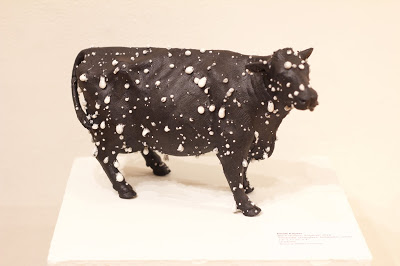
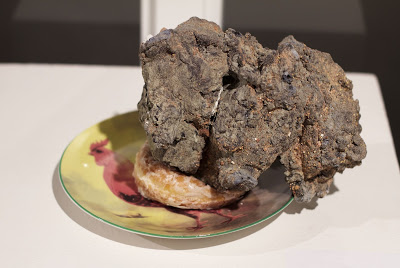
I was curious about the lifespan of the donut. Pasquale told me she does not treat it with anything, replacing the donut if it's part of a new show or she's taking photos. She says, "The donut looks so good when the glaze is still wet and drippy, but the reception didn't line up with that part of the piece's life cycle."
I had most fun with Kingshill's Dream Truck. Coming upon it, I gave in to the urge to pick it up. In doing so, I realised it came apart -- the surfboard was completely unattached and the whole cab was removable, too. Surprised and delighted I took the cab off and placed the board in the flatbed of the truck. That was about as far as it went; I was tempted to take it off the pedestal, onto the floor, but resisted.
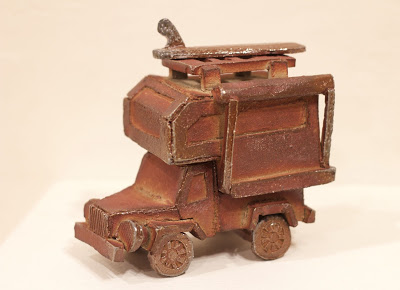
I emailed a bit with Patrick Kingshill and he said that Dream Truck represents a departure from his normal practice of making functional vessels. He is an 'obsessive doodler' who grew up in Eureka on the coast of Northern California and has surfed since he was 14. The downside to getting a grad degree in Nebraska = it's very far from the surf. This latent desire really came out in this three-dimensional doodle.
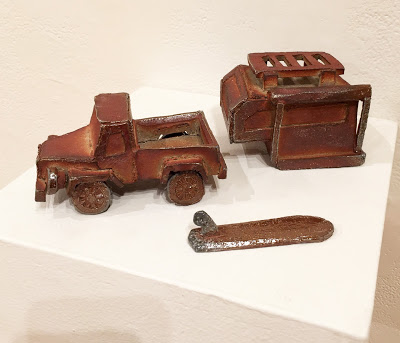
No one saw as I gingerly put it back together.
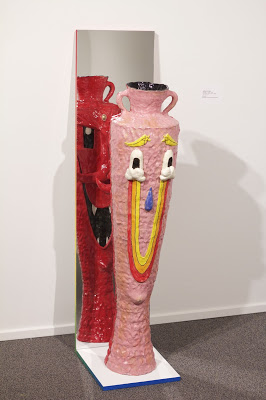
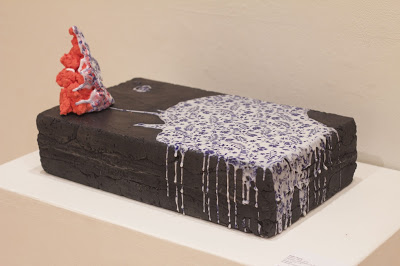
I have to admit that some pieces fell flat in my eyes; Bevington's It's okay... I'm okay was simply silly, and I did not find much significance in Jeong's Want to Value.

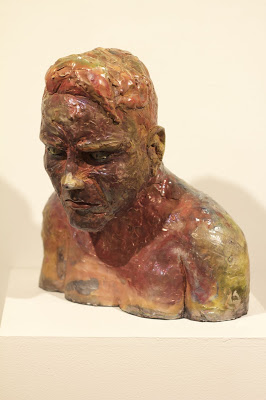
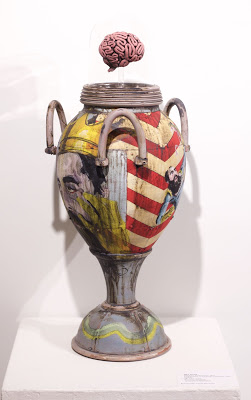
To my mind, there is something inherently special about a well-conceived and executed functional pot; the possibility of its use imbues it with some sort of magic. But this magic was present in Kingshill's Truck, too. I wanted to take it apart and play with it. And that is not to say I value function over all else, but it certainly informs my aesthetic inclination. Would I enjoy Cinelli's Reliquary for Boredom more if it 1) were an open vessel 2) did not have a brain hovering over it and 3) did not have a fancy title? Possibly. Why? I don't know. Maybe because I am a peasant potter at heart.
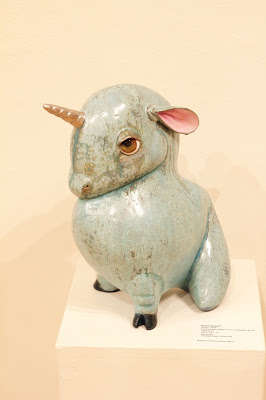
There's more under the surface of my present thoughts, bugging me. Take Ballard's Brave, for instance. What does a peasant potter do with that? It's earthenware, sure, but with nail polish?
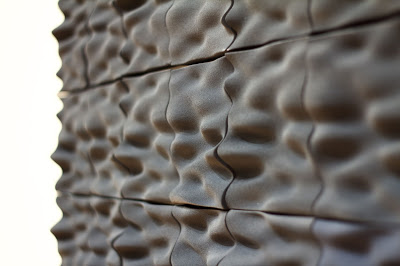
I don't know. I'm confused. That's NCECA. Maybe that's the point. Maybe it's fine. I should probably let go and embrace the collisions. Here's a last couple of pieces with fantastic surface and texture.

Being in the gallery after hours, on the night of the reception, there was a kind of leftover electricity in the air. The feeling that hundreds of people had already traipsed through and had their fill. Despite the lack of functional work, I enjoyed the show; the choices were whimsical. I particularly enjoyed Kaysner's cow, with weeping feldspatic chunks, and Pasquale's utterly squashed donut.
I have not included all of the pieces in the show, but most of them, with links to the artists websites where available.
Black Holstein Shigaraki, Elliot Kaysner, 2016.
Terracotta, underglaze, felspathic chunks. Graduate, Arizona State University.
Regretting Yet Wanting, Taylor Pasquale, 2016.
Ceramic materials, ceramic plate, donut. Graduate, Kent State University.
I had most fun with Kingshill's Dream Truck. Coming upon it, I gave in to the urge to pick it up. In doing so, I realised it came apart -- the surfboard was completely unattached and the whole cab was removable, too. Surprised and delighted I took the cab off and placed the board in the flatbed of the truck. That was about as far as it went; I was tempted to take it off the pedestal, onto the floor, but resisted.
Dream Truck, Patrick Kingshill, 2016.
Ceramic. Graduate, University of Nebraska-Lincoln.
I emailed a bit with Patrick Kingshill and he said that Dream Truck represents a departure from his normal practice of making functional vessels. He is an 'obsessive doodler' who grew up in Eureka on the coast of Northern California and has surfed since he was 14. The downside to getting a grad degree in Nebraska = it's very far from the surf. This latent desire really came out in this three-dimensional doodle.
Dream Truck, Patrick Kingshill, 2016.
Ceramic. Graduate, University of Nebraska-Lincoln.
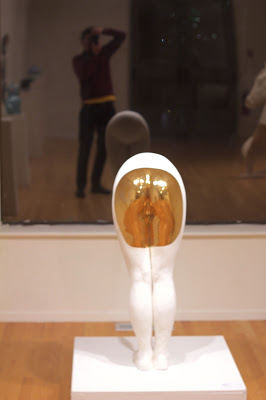
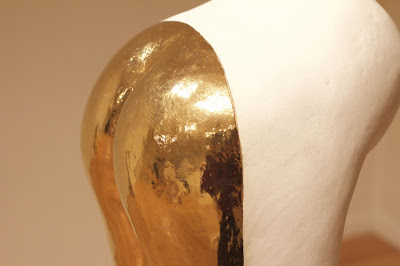
I did not touch Franco's Golden. In fact, I felt rather awkward examining and taking pictures of her golden behind. Imagine applying that lustre in the studio.
Golden, Lorraine Franco, 2016.
Ceramics. Undergraduate, University of Miami.
Golden, Lorraine Franco, 2016.
Ceramics. Undergraduate, University of Miami.
It's okay... I'm okay. Ashley Bevington, 2016.
Clay, glaze, wood, mirror, paint. Graduate, Edinboro University of Pennsylvania.
Want to Value, Kwan Jeong, 2016.
Porcelain, underglaze, low firing glaze. Graduate, Syracuse University.
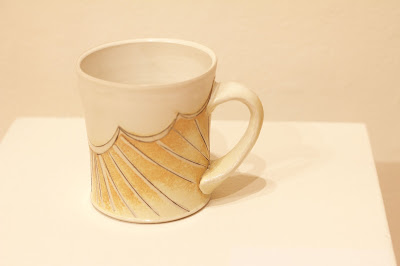
Overall, I was left wanting more pots. There were only four representatives of functional ceramics in the exhibition. When I got to McDaniel's Sunshine Mug I had this sense of deja vu because, as I realised later, it had been featured in the NCECA Program guide. It made me laugh at the time though... to have a simple, yet well-made, mug sat right next to Fahley's deconstructed horse. It felt totally incongruous... as if someone in charge had been like "oh shit, we need a cup in the show."

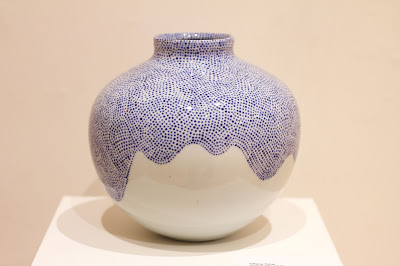
I thought the other two functional pieces were thoughtfully placed, though: Tang's porcelain jar stood out, with its bright shiny porcelain surface and obsessive blue dots, complemented by Deroualle's soft panels nearby.


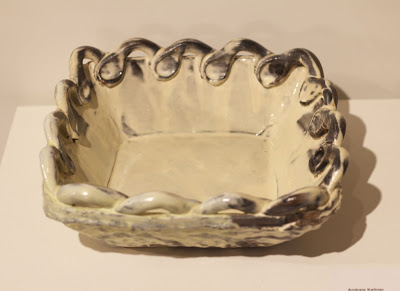
Sunshine Mug, Caelin McDaniel, 2016.
Stoneware. Undergraduate, Edinboro University of Pennysylvania.
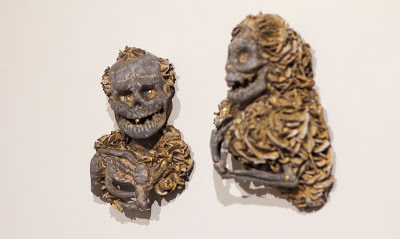
| Survived by:, Shauna Fahley, 2016. Ceramic, wood, resin. Undergraduate, University of Washington. Stuart Gair's tea set also felt out of place, as if stranded on a life-raft in a choppy sea of ardently Parisian coffee drinkers. 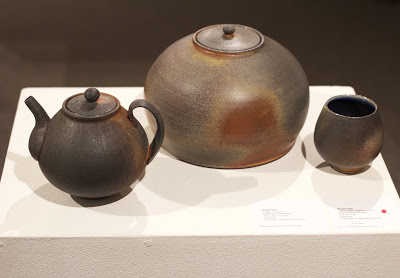
Large jar, teapot and teabowl, Stuart Gair, 2016.
Soda fired stoneware. Graduate, University of Nebraska-Lincoln.
|
I thought the other two functional pieces were thoughtfully placed, though: Tang's porcelain jar stood out, with its bright shiny porcelain surface and obsessive blue dots, complemented by Deroualle's soft panels nearby.
Individuality, Tiffany Tang, 2016.
Porcelain. Graduate, University of Montana.
Untitled, Louise Deroualle, 2016.
Ceramic. University of Nebraska, Lincoln.
Close ups...
Individuality, Tiffany Tang, 2016.
Porcelain. Graduate, University of Montana.
Untitled, Louise Deroualle, 2016.
Ceramic. University of Nebraska, Lincoln.
And I chuckled at the ironic placement of Kellner's earthenware Meat Tray underneath Larrabee's skeletal Companions.
Companions, Teresa Larrabee, 2016.
Stoneware, underglaze, mixed media. Post-baccalaureate, University of North Texas.
Meat Tray, Andrew Kellner, 2016.
Earthenware. Graduate, West Virginia University.
I thought, to begin, that the show's main collision was between 'art' and 'craft.' But then, it is not that simple -- many of the sculptures, such as Wilson's Foul Fowl and Calhoun's Self-Image, are finely crafted, and Tang's piece could be seen as Art with a capital A. Perhaps a better way to describe the collision is between the 'conceptual art piece' and the 'functional pot.' This is the great dichotomy of the current ceramic art world, especially that of university programs. Students seem to be pushed to conceptualise first and make second.
Foul Fowl, Mary Cale Wilson, 2016.
Earthenware. Graduate, San Diego State University.
Self Image, Liam Calhoun, 2016.
Raku fired ceramic. Undergraduate, Buffalo State College.
To my mind, there is something inherently special about a well-conceived and executed functional pot; the possibility of its use imbues it with some sort of magic. But this magic was present in Kingshill's Truck, too. I wanted to take it apart and play with it. And that is not to say I value function over all else, but it certainly informs my aesthetic inclination. Would I enjoy Cinelli's Reliquary for Boredom more if it 1) were an open vessel 2) did not have a brain hovering over it and 3) did not have a fancy title? Possibly. Why? I don't know. Maybe because I am a peasant potter at heart.
Reliquary for Boredom, Mike Cinelli, 2016.
Earthenware, commercial underglaze, terra sigilata. Post-baccalaureate, University of Mississippi.
Brave, Rachel Ballard, 2016.
Earthenware glaze, micro-crystalline glaze, nail polish. Graduate, Georgia State University.
I don't know. I'm confused. That's NCECA. Maybe that's the point. Maybe it's fine. I should probably let go and embrace the collisions. Here's a last couple of pieces with fantastic surface and texture.
Blue Velvet Water, Sarah Heitmeyer, 2016.
Slip cast porcelain, glaze. Graduate, SUNY New Paltz.
Squares on Squares on Square, 2016, Yewen Dong.
Ceramic. Graduate, School of Art Institute of Chicago.
Squares on Squares on Square, 2016, Yewen Dong.
Ceramic. Graduate, School of Art Institute of Chicago.
I can't help feeling that we should have separate exhibitions for students' functional and conceptual pieces, but the clash of them can indeed be compelling. Perhaps I just want a fairer representation of the excellent functional pots being made out there. I want them to be prominent and not feel like afterthoughts. Here is my afterthought for now... LeFever's untitled wall sculpture. It was made originally with a 3D printer and then slip cast from that. The world's a changing.
Untitled, Amy LeFever, 2016.
Slip cast earthenware from 3D printed model, designed in Rhino software program. Graduate, University of Tennessee, Knoxville.
Mark Hewitt: Ginger Jar Production. Spring, 2017.
I was invited by the Boston-based Pucker Gallery to do a take-over of their Instagram account a couple of weeks ago. The Pucker Gallery represents my mentor and boss Mark Hewitt, and they are currently having an exhibition of his work.
Generally I don't get the opportunity to take a lot of snaps at work, since I'm busy with other tasks and my own pots. I thought it would be nice to share some of the pictures that I posted for Pucker with some of the nearly-made-its. They follow Mark's ginger jars throughout the week. There are a few pictures to provide context, and some videos, too. I appreciated having the chance to record Mark's process a bit more, too.

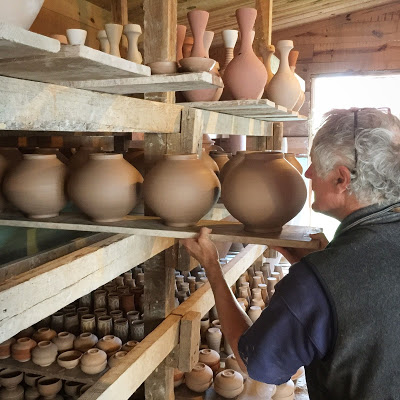


Now I really need to pack as we leave for NCECA in Portland tomorrow and it's late and I am horribly unprepared. First task: find my waterproofs.
Generally I don't get the opportunity to take a lot of snaps at work, since I'm busy with other tasks and my own pots. I thought it would be nice to share some of the pictures that I posted for Pucker with some of the nearly-made-its. They follow Mark's ginger jars throughout the week. There are a few pictures to provide context, and some videos, too. I appreciated having the chance to record Mark's process a bit more, too.
Good morning from the Hewitt Pottery! Mark is in full flow churning out ginger jars this morning. He started with 18 little 1 1/2lb bodies and is on to 2 1/4lb ones now. This one is about to come off the wheel. Larger ginger jars to follow after lunch. This is the first post of this weeks insta take over by me @hamramics by the way.
Last board of the day-board number 6-slides into the drying rack. Now Mr Hewitt is going to get on with making lids and I'm heading home. More pics to follow tomorrow!
The potters hands! Mark finishing up his batch of lids this morning. He'll get them out in the sun to dry and add the knobs this afternoon.
Mark trimming up the lids for his ginger jars and adding knobs. Only 40 more to go!
How do you know it's a Mark Hewitt? The stamp on the right is Mark's monogram. W.M.H all rolled into one. The 'elle' refers to the firing... we go numerically in the salt kiln and alphabetically in the newer wood kiln. Elle = L so this will be the twelfth firing of the kiln.
Mark trimming up the lids for his ginger jars and adding knobs. Only 40 more to go!
Trimmed up lid with its freshly thrown knob. Two expectant ginger jars in the background. Happy women's day!
Some of Mark ginger jars about to be put under plastic to await decoration on Friday. He's flying along making larger 5lb and 8lb jars today, whilst @stillyv (my fellow apprentice) and I clean and wash kiln furniture.
Stillman weighing out some balls of clay for himself.
Mark throwing larger ginger jars later in the week-8lb ones.
The look much larger in real life.
The master at work, from above.
8lb jar from the side.
Here's a view from across the pond. Mark's house in the front, the barn which we use as a gallery at the kiln openings in the back and the solar panels that power the property on the right. The workshop and kiln are obscured from this angle but I'll get there later. This is @hamramics reporting from the Hewitt Pottery.
View from the roof of the kiln shed.
We ran out of space for pots in the workshop so have had to store some in the back chamber of Mark's newer wood kiln. His mugs up front and some of my teapots etc behind.
This is the salt kiln that Mark built in his first year in Pittsboro (1983). It has seen 96 firings so far and shows no signs of falling apart yet. Touch wood. The design was based on Thai climbing kilns and came together with the help of Svend Bayer. The kiln fits so many pots it takes us a full week to load. We light the fire (generally) on a Wednesday afternoon and finish firing on Saturday afternoon. It's an epic and crucial endeavor-4 months worth of work all inside one kiln. Once fired we wait a week for it to cool and then get to crack it open and see how they came out.
I think this is the heart of the Hewitt Pottery: the dirt floor of the workshop. It is gnobbled and gnarled from years of potters' feet walking to and fro. The bumps are hardened like polished river stones and can easily put you off balance if you take a wrong step. Carrying boards of pots felt dangerous when I begun my apprenticeship, just as I'm sure actors quiver as they "tread the boards" for the first time on the main stage.
When people arrive, they always react to it; once a group of kids from a school for the blind visited and were excited to find such a bumpy landscape in the studio. Mark calls it his air conditioning unit as it helps keep the workshop cool in the summer (perhaps cool is an overstatement). My favorite feature is its ability to absorb all sorts of spills; splashes of water or glaze or clay disappear underfoot. We have to sweep very infrequently, and when we do it is with the romantic sense and dusty scent of being a potter sweeping a dirt floor. I could go on, but will spare you. I say tear up your concrete floors and go back to bare earth!
End of the day. Mark working on lids, Stillman watching, barefoot as usual!
Mark decorating one of his fat 5lb ginger jars this afternoon. Red slip banding with white slip swirls. Mark is working on the treadle wheel that he built when he first started the pottery.
Closer angle - different pot but same idea!
Freshly trailed jars.
Mark switching between the treadle wheel and one of our electric wheels.
I asked Mark to give me his best Ai Weiwei pose. Here it is. You'll be glad to know he didn't actually drop the jar.
This is the final post of my Pucker Gallery takeover. It's been a fun week sharing pictures from the pottery. I thought it fitting to end on a pic of the current team... Mark (@wmhewitt) on the right, me in the middle (@hamramics) and my fellow (barefoot) apprentice Stillman Browning-Howe (@stillyv) on the left. Thank you @puckergallery for inviting me to do this!
...